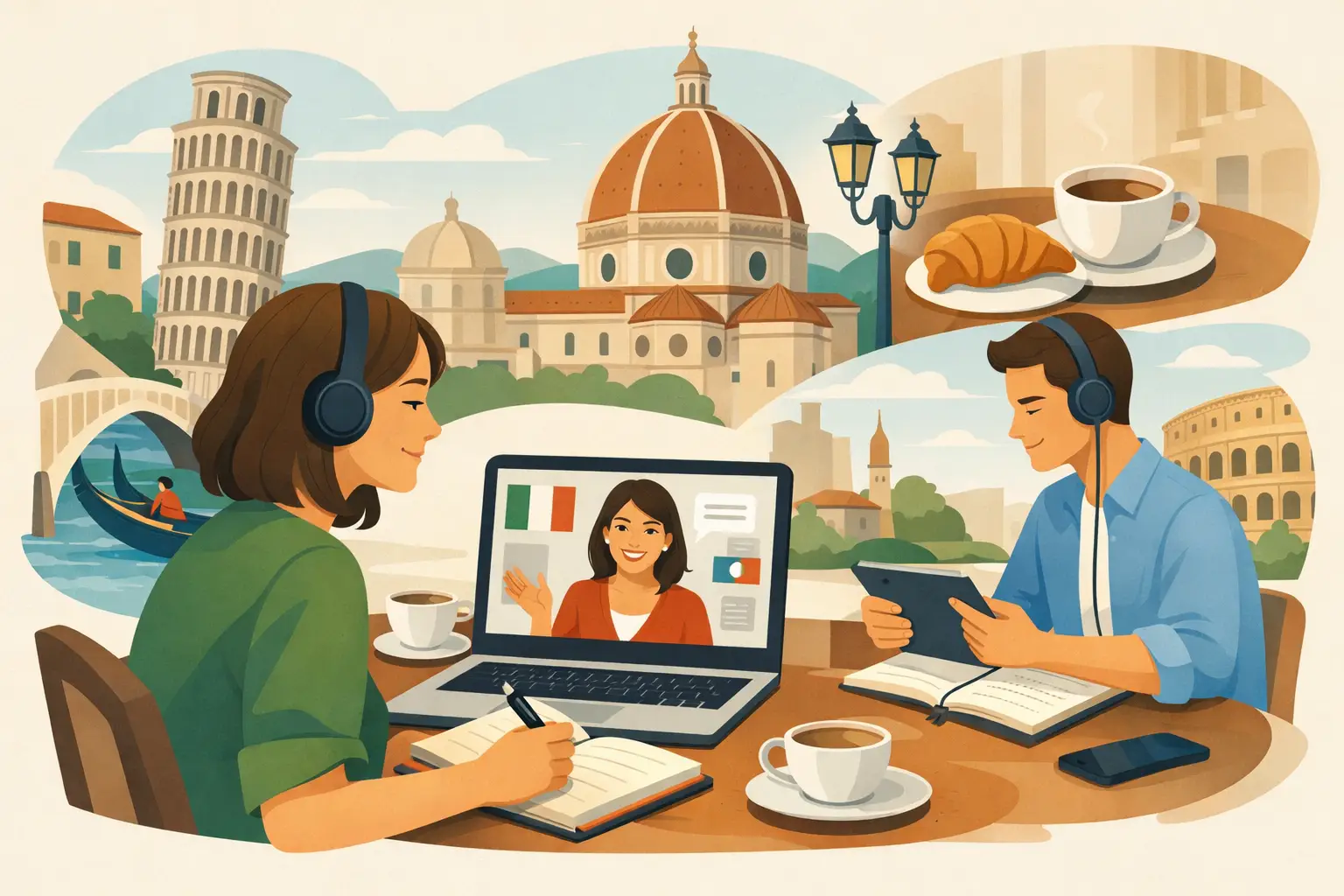
You do not need to memorize a wall of verb charts before you can say something meaningful in Italian. The best Italian lessons for complete beginners give you useful language early: how to introduce yourself, ask for coffee, understand a simple reply, and recover gracefully when you miss a word.
That matters because most adults do not start learning Italian simply to pass a test. You may be planning a trip, speaking with family, preparing for a move, or finally giving proper attention to a language you have loved for years. Whatever brings you here, your first lessons should make Italian feel usable, not intimidating.
What complete beginners actually need
A complete beginner does not need to know every rule. You need a clear sequence, frequent chances to listen and speak, and enough repetition for common phrases to become familiar. Grammar belongs in the process, but it should explain the language you are using rather than become the whole lesson.
In Daniele’s classes with adult learners from many countries, one pattern comes up again and again: students gain confidence when they can make a small exchange work. Saying Buongiorno, vorrei un caffè, per favore is more motivating than studying a long vocabulary list about a café without ever speaking it aloud.
A well-designed beginner course usually develops four connected skills: listening, speaking, reading, and writing. At first, these do not need equal time. Listening and speaking deserve extra attention because Italian is a living, social language. Reading supports you, while short writing tasks help you notice patterns and remember what you have learned.
A practical path through your first Italian lessons
Start with sounds, greetings, and survival phrases
Italian spelling is relatively consistent, which is good news for beginners. Once you learn the basic sound patterns, you can read many new words with reasonable confidence. Still, a native teacher can help you hear details that English speakers often overlook, such as the difference between casa and cosa, or the strong double consonant in pizza.
Your opening lessons should include greetings, polite expressions, numbers, and simple questions. You might practice this short exchange:
A: Ciao, come ti chiami? B: Mi chiamo Sarah. E tu? A: Io sono Marco. Piacere!
This is not just a script to recite. It teaches a useful conversational rhythm: greeting, question, answer, and response. From there, you can change the names, ask where someone is from, or say what languages you speak.
Learn useful chunks before analyzing every word
Beginners often ask whether they should learn individual vocabulary words or full sentences. The answer is both, but phrases are the faster route to conversation. A chunk such as Non capisco – “I don’t understand” – is immediately useful, even before you can explain why the verb changes form.
Build a small bank of expressions you can use repeatedly: Come si dice…?, Puoi ripetere, per favore?, Vorrei…, and Dov’è…? These phrases give you a way to participate even when your vocabulary is still limited.
Anna often sees students become much less anxious once they have language for managing a conversation. You do not need perfect Italian to ask someone to speak more slowly. You need the confidence to say, Puoi parlare più lentamente, per favore?
Add grammar in small, useful pieces
Italian grammar can look daunting when presented all at once. Gender, articles, verb endings, and agreement are real parts of the language, but beginners learn them more effectively in context.
For example, when learning to order, you may meet un caffè, una pizza, and due panini. This introduces articles and gender naturally. Later, you can look more closely at why un and una change. The goal is not to avoid grammar. It is to learn grammar at a pace that helps you communicate.
At this stage, focus on present-tense verbs you need often, including essere (to be), avere (to have), fare (to do or make), andare (to go), and volere (to want). Rather than trying to recite every possible form, use them in sentences connected to your life: Sono americano, ho una sorella, voglio visitare Roma, vado al lavoro.
Why speaking early makes a difference
Many adults wait to speak until they feel ready. Unfortunately, readiness rarely arrives through silent study alone. Speaking reveals what you know, what you need, and which sounds or structures need more practice.
This does not mean being put on the spot in a large class. A supportive beginner environment gives you time to prepare, hear examples, and try again. Small live classes are especially helpful because a teacher can correct one or two high-value points without interrupting every sentence.
For instance, if you say Io want a coffee, the useful next step is not a lengthy lecture. It is hearing and repeating Vorrei un caffè. Then you use it in a few different situations. Correction should help you keep moving.
Create a routine you can actually maintain
Consistency beats occasional marathon sessions. If you are busy, aim for several short contacts with Italian each week: a live lesson, a review session, a few minutes of listening, and a short speaking exercise. The exact schedule depends on your work and family commitments, but the language needs to appear often enough that it stays familiar.
A realistic weekly routine could include a structured class, two 15-minute review sessions, and one moment of active listening with a transcript or subtitles. Review the same material before adding too much new content. Beginners often mistake recognition for recall: seeing grazie and knowing its meaning is different from producing it naturally in a conversation.
Keep a notebook or digital document for phrases that matter to you. A traveler may collect hotel and restaurant language. A heritage learner may write down family questions. A professional may begin with greetings, schedules, and introductions. Personal relevance makes repetition easier.
Choose beginner instruction that fits your goal
There is no single perfect format for everyone. A self-paced video course can work well if your schedule changes each week and you are comfortable organizing your own review. Live group lessons add regular speaking practice, teacher feedback, and the encouragement of learning alongside others. Private lessons are useful when you have a specific deadline or want each class centered on your needs.
The trade-off is simple: flexibility requires more self-discipline, while scheduled lessons create accountability but ask you to protect time on your calendar. Many learners benefit from a blend of both. At The Italian Lesson, beginners can combine structured teaching with downloadable resources, exercises, and authentic listening materials, so class time does not have to carry the entire learning process.
Whichever format you choose, look for native-speaker input, a clear progression, opportunities to speak, and materials that sound like real Italian. You are learning more than a set of translations. You are learning how Italians greet, clarify, react, and connect.
Common beginner mistakes worth avoiding
Trying to translate every English sentence word for word will slow you down. Italian often organizes ideas differently, and that is normal. Learn the Italian expression as it is used rather than forcing it into English structure.
It also helps to avoid collecting too many apps, books, and videos at once. A few reliable resources used consistently are better than ten resources you open once. Finally, do not judge progress only by how much vocabulary you have memorized. Notice whether you can understand a familiar question, answer with less hesitation, or handle a short exchange without switching to English.
FAQ
Can I learn Italian if I know absolutely nothing?
Yes. Italian courses for absolute beginners are designed to start with the basics: pronunciation, greetings, everyday vocabulary, and simple sentences. You do not need prior language-learning experience, only a willingness to practice regularly.
How long does it take to speak basic Italian?
It depends on how often you study, how much speaking practice you get, and what “basic” means for your goal. With consistent lessons and review, many learners begin handling short, familiar exchanges within the early stages of a course. Comfortable conversation takes longer and grows through repeated use.
Should beginners learn Italian grammar first?
No. Learn grammar alongside useful language. Understanding articles and verb forms will help you progress, but starting with phrases and real situations gives those rules a purpose.
Are online Italian lessons good for complete beginners?
They can be an excellent choice, especially when lessons include live interaction, clear materials, feedback from a native teacher, and time to review between classes. The key is active participation, not simply watching lessons passively.
What is the best way to practice Italian pronunciation at home?
Listen to short recordings, read along with a transcript when available, repeat aloud, and record yourself occasionally. Focus on a few sounds at a time. Regular imitation is more helpful than trying to perfect every word in one session.
Your first Italian sentence may be simple, but it is the beginning of a real conversation. Give yourself permission to be a beginner, speak before you feel flawless, and let each small exchange carry you toward the next one.