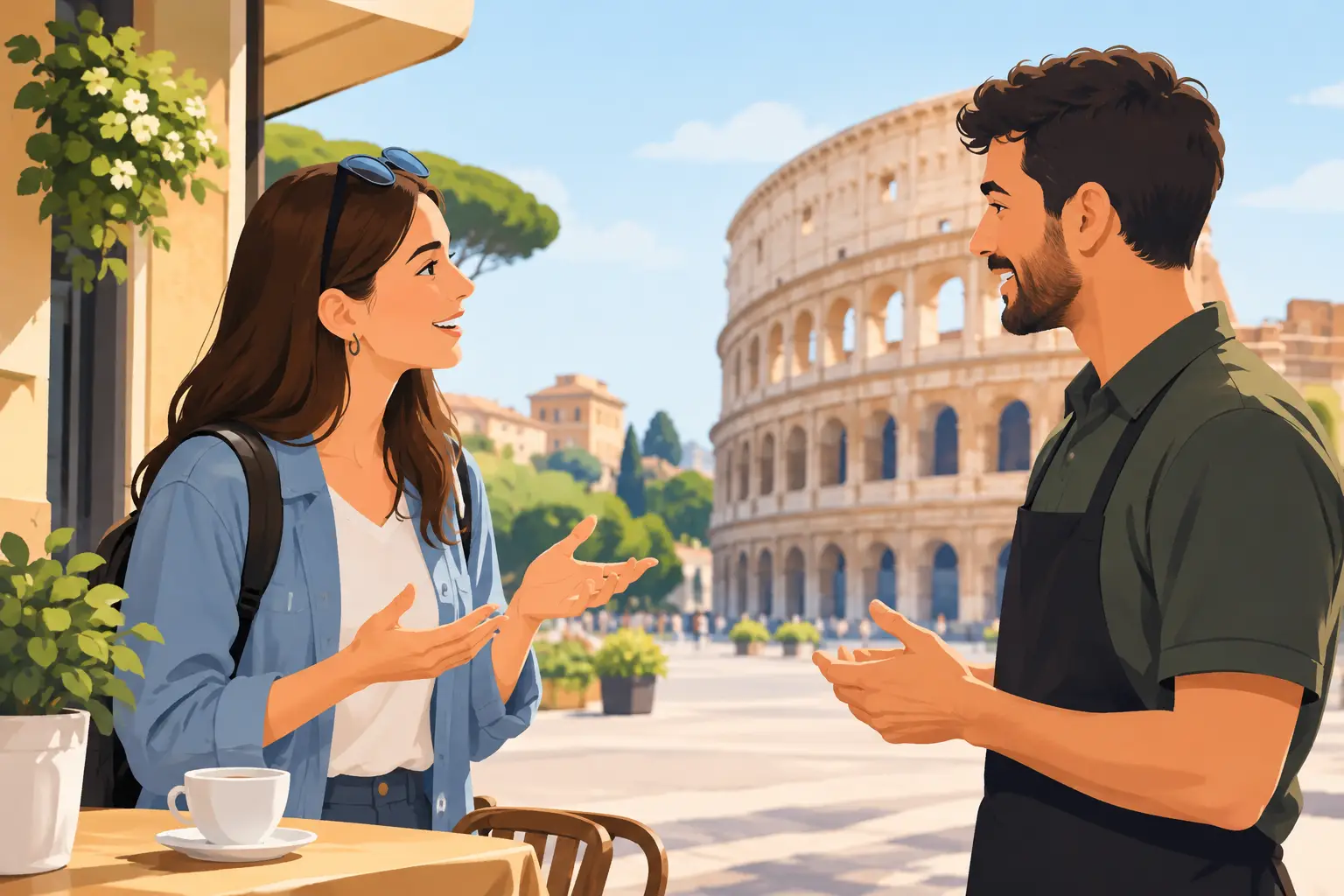
A phrasebook can help you order coffee, but it often leaves you stranded the moment an Italian replies with a question. This Italian travel phrases guide is designed for the moments that make a trip feel easier: asking for help, checking into a hotel, buying a train ticket, and responding politely when someone speaks faster than you expected.
After teaching adult beginners for years, Daniele and Anna have seen the same pattern. Students do not need hundreds of isolated words before traveling. They need a small set of flexible phrases, the confidence to use them, and a few ways to keep a conversation going.
Start with the phrases Italians use every day
The most useful travel Italian is polite, clear, and reusable. Rather than memorizing a long list, learn phrases in small groups that fit real situations.
Greetings and polite basics
Start most interactions with buongiorno (good morning/good day) or buonasera (good evening). In shops, hotels, and restaurants, these are more natural than opening immediately with a request.
Say per favore for “please” and grazie for “thank you.” If someone helps you, grazie mille means “thank you very much.” A useful reply to thanks is prego, which can mean “you’re welcome,” but also “go ahead” or “after you.” Context does the work.
When you need to get someone’s attention, try mi scusi (excuse me). This is the polite form and works well with strangers. You may hear scusa among friends or younger people, but travelers are usually better served by mi scusi.
A simple opening can sound like this:
You: Buongiorno, mi scusi. Parla inglese?
Local: Un po’. Come posso aiutarla?
You: Vorrei comprare un biglietto per Firenze, per favore.
This means: “Good morning, excuse me. Do you speak English?” “A little. How can I help you?” “I’d like to buy a ticket to Florence, please.”
Notice vorrei. It means “I would like” and is one of the best words to learn before a trip. It sounds courteous without being overly formal.
Italian travel phrases guide: getting around
Italy’s trains and local transportation are manageable when you can recognize a few essential words. Biglietto means ticket, binario means platform, stazione means station, and fermata means stop.
At a ticket office or counter, you can say: Vorrei un biglietto per Roma, per favore – “I’d like a ticket to Rome, please.” If you need a round trip, ask for andata e ritorno. For a one-way ticket, say solo andata.
A few practical questions are worth practicing aloud:
- Da quale binario parte il treno? – Which platform does the train leave from?
- A che ora arriva? – What time does it arrive?
- Questo treno va a Milano? – Does this train go to Milan?
- Dove devo cambiare? – Where do I need to change trains?
On buses, you may need Dove posso comprare il biglietto? – “Where can I buy the ticket?” In many cities, tickets must be purchased or validated before boarding. Procedures vary by region and transport provider, so asking is better than assuming.
For directions, learn a destra (to the right), a sinistra (to the left), sempre dritto (straight ahead), and vicino (near). A very useful question is È lontano da qui? – “Is it far from here?”
If the answer comes too quickly, do not panic. Say Può ripetere, per favore? – “Can you repeat that, please?” Or slow the pace politely with Può parlare più lentamente? – “Can you speak more slowly?” These are communication tools, not signs that you have failed.
At hotels, restaurants, and shops
At a hotel, Ho una prenotazione a nome di… means “I have a reservation under the name of…” If you have a question about the room, try La colazione è inclusa? (Is breakfast included?) or A che ora devo lasciare la camera? (What time do I need to check out?).
In restaurants, un tavolo per due, per favore is “a table for two, please.” You can ask Possiamo avere il menù? – “Can we have the menu?” In Italy, you may see coperto, a cover charge often listed on the menu. It is not a tip, and it is common in many restaurants.
When ordering, use Prendo… for “I’ll have…” and Vorrei… for “I would like…” Both work. For example: Prendo gli spaghetti al pomodoro e un’acqua naturale. Natural water is still water; frizzante means sparkling.
Dietary needs deserve a little extra preparation. Say Sono vegetariano if you are male or sono vegetariana if you are female. For an allergy, say Sono allergico/a a… followed by the food: noci (nuts), latte (milk), or glutine (gluten). It helps to be specific and to ask: Questo piatto contiene…? – “Does this dish contain…?”
In a store, Posso pagare con la carta? means “Can I pay by card?” and Quanto costa? means “How much does it cost?” If you are simply looking around, Sto solo guardando, grazie is a friendly “I’m just looking, thank you.”
The cultural skill behind the words
Good travel Italian is not only vocabulary. It is knowing how to enter an interaction. In many Italian settings, greeting first matters. Walking into a bakery and beginning with Buongiorno before asking for bread is a small gesture, but it changes the tone of the exchange.
Formality also depends on context. Italian has informal tu and polite Lei, but visitors do not need to memorize every verb form immediately. Phrases such as mi scusi, vorrei, and può aiutarmi? naturally keep your tone respectful. As Anna often tells students, politeness is not about sounding stiff. It is about showing that you recognize the other person.
Italy is also diverse. A phrase you hear in Naples may differ from one used in Milan, and local accents can make familiar words sound new. Standard Italian will serve you almost everywhere, while curiosity and patience will carry you through the rest.
Practice before you leave
Try these short situations out loud. The goal is not perfect grammar. It is being ready to respond when the moment arrives.
Exercise 1: Choose the most useful phrase
You are at a station and cannot find your platform. Which phrase fits best?
A. Quanto costa?
B. Da quale binario parte il treno?
C. Ho una prenotazione.
Exercise 2: Complete the request
Fill in the blank: _______ un biglietto per Venezia, per favore.
Choose Vorrei or Buonasera.
Exercise 3: Build a mini-dialogue
You need help finding the bathroom in a museum. Put these ideas into a polite Italian request: “Excuse me, where is the bathroom?”
Answer key
- B: Da quale binario parte il treno?
- Vorrei un biglietto per Venezia, per favore.
- Mi scusi, dov’è il bagno? You can also say Dove si trova il bagno? Both are natural.
Frequently asked questions
What are the most important Italian phrases for first-time travelers?
Begin with buongiorno, mi scusi, per favore, grazie, vorrei…, dov’è…?, and può ripetere? These phrases allow you to greet, ask, order, find places, and repair a conversation when you do not understand.
Should I use tu or Lei when speaking Italian in Italy?
With hotel staff, shop assistants, older adults you do not know, and anyone in a professional setting, polite language is the safer choice. You do not need to analyze every situation. Use phrases like mi scusi and vorrei, and follow the other person’s lead if they become more informal.
Can I travel in Italy with only basic Italian?
Yes, especially in major tourist areas, but basic Italian makes ordinary interactions warmer and less stressful. You may find English spoken widely in some places and less often in smaller towns. A few prepared phrases give you options either way.
How do I say I do not understand in Italian?
Say Non capisco – “I don’t understand.” For a softer, more specific response, say Non ho capito – “I didn’t understand.” Follow it with Può ripetere, per favore? or Può parlare più lentamente?
What Italian should I learn beyond travel phrases?
Travel phrases are a starting point, not a complete conversation. Learn common question words, present-tense verbs such as essere, avere, and volere, and everyday listening skills. In live classes at The Italian Lesson, students practice these building blocks in realistic conversations so the phrases become flexible rather than memorized scripts.
Before your trip, choose ten phrases that match your actual plans and say them aloud every day. A friendly greeting, a clear request, and the willingness to ask someone to repeat themselves can turn a short exchange into a genuine connection.