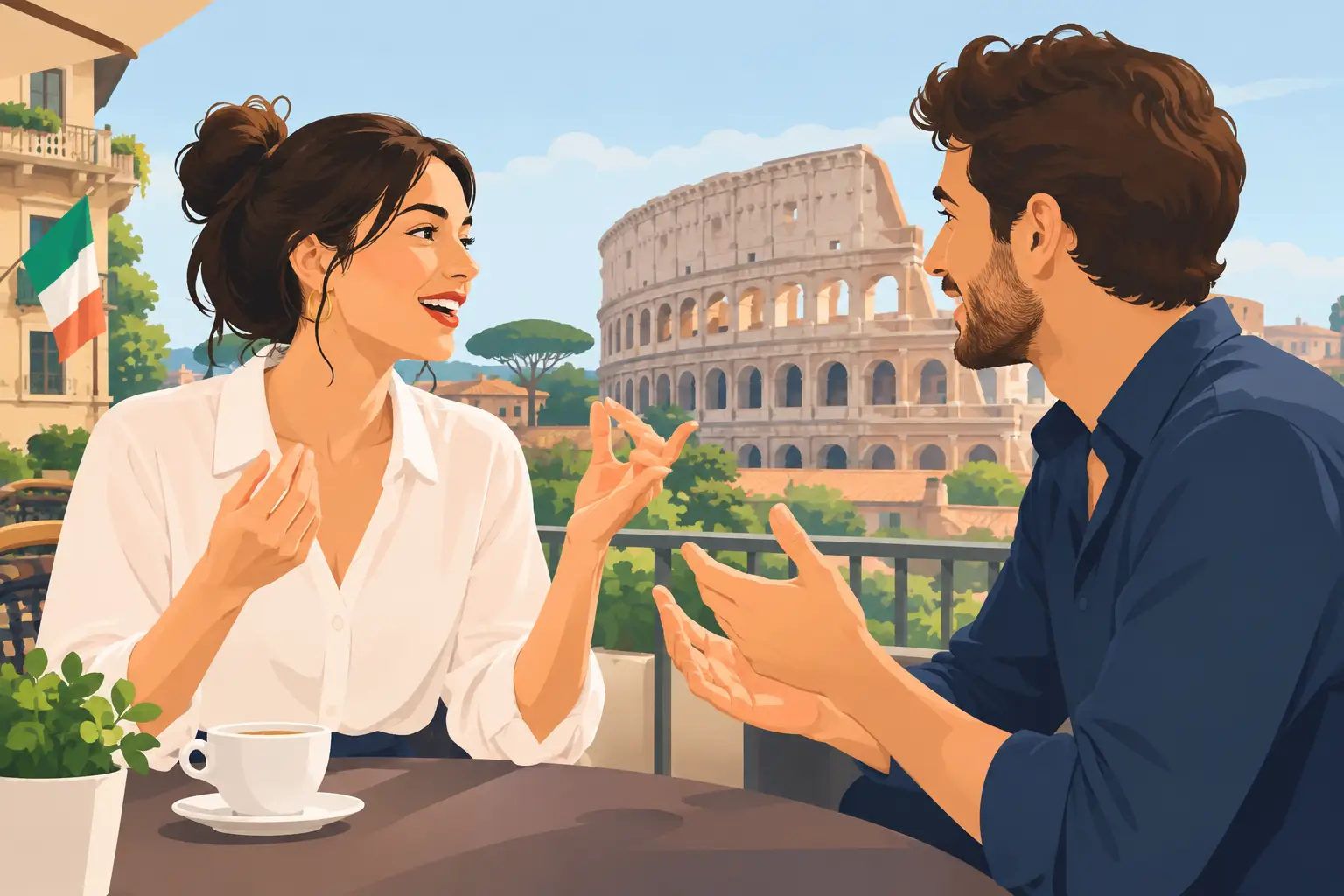
At a busy bar in Naples, Milan, or a small town in Puglia, you may notice a conversation continuing even when nobody is speaking. A raised hand, a slight shrug, fingers gathered together, a quick movement of the chin: these details can carry feeling, timing, and intention. So, do Italians gesture? Absolutely. But the familiar image of every Italian speaking with dramatic hand movements is only part of the story.
For Italian learners, gestures are worth paying attention to because they help you understand real conversation. They can signal impatience, agreement, uncertainty, warmth, or irony. They do not replace Italian words, though, and they are not a universal dictionary of fixed meanings. The same gesture can change according to the speaker, the region, the relationship, facial expression, and tone of voice.
Do Italians gesture more than other people?
Many Italians use gestures often in everyday conversation, especially when telling a story, emphasizing a point, or reacting emotionally. This does not mean every person gestures in the same way. Italy has strong regional identities, different family habits, and generations with different communication styles. A quiet office meeting in Turin may look very different from a lively family lunch in Palermo.
Gestures are also not limited to Italy. People everywhere use their hands when they speak. What learners often notice in Italian is the variety of recognizable gestures and how naturally they work alongside short expressions such as mah, boh, magari, and basta.
Daniele often tells students not to treat gestures as a performance. If you try to add a new gesture to every sentence, you will probably feel distracted and look uncomfortable. First, listen for the words, notice the speaker’s expression, and let your own body language become more natural over time.
Why gestures matter when learning Italian
A gesture can help you understand what a speaker means beyond the literal words. Consider the phrase Va bene. On paper, it simply means “okay” or “all right.” Said with a smile and a small nod, it is genuine agreement. Said with a long pause, a tilted head, and raised eyebrows, it may mean, “Fine, if you insist.”
This is one reason authentic listening matters. Language learners can know the grammar and still miss the mood of a conversation. In live classes, Anna often asks students to pay attention to the whole message: the words, pace, intonation, face, and hands. That is where conversational confidence begins.
Gestures can also make your Italian easier to follow when your vocabulary is still growing. If you are describing a tiny apartment, showing “small” with your hands supports the word piccolo. If you are explaining that a restaurant was packed, a gesture can add energy to c’era tanta gente. Use them as support, not as a substitute for saying what you mean.
A few gestures you may see in Italy
The best way to learn gestures is in context, but a few common examples can help you recognize them.
Fingers gathered upward: “What do you mean?”
The famous gesture with fingertips gathered together and facing upward can express several things. Often it means “What are you saying?” or “What do you want?” The movement, facial expression, and situation make the difference.
If a friend arrives an hour late, they might say:
Ma che fai? Ti aspettiamo da un’ora!
“What are you doing? We have been waiting for you for an hour!”
With a playful tone, this can be affectionate teasing. With a sharp tone, it can be real annoyance. Do not copy it with strangers until you have heard how it is used around you.
A hand under the chin: “I don’t care”
Brushing the fingers outward from under the chin can mean “I do not care” or “Forget it.” It is expressive and can come across as dismissive, so it is best understood before it is used.
Imagine someone complaining for ten minutes about a movie they chose themselves. Their friend may respond, Mah, per me… followed by the gesture. The words and the gesture together communicate indifference.
A shrug with boh: “Who knows?”
This is one of the safest and most useful combinations for learners. Boh means something like “I have no idea” or “who knows?” A shrug makes the uncertainty even clearer.
A che ora arriva Marco?
Boh, forse alle otto.
“What time is Marco arriving?”
“No idea, maybe at eight.”
You do not need to force the shrug. Most English speakers already use one naturally.
A small twist of the hand: “So-so”
A hand moving gently from side to side can accompany così così, meaning “so-so.” It is useful when the answer is neither positive nor terrible.
Com’è andato l’esame?
Così così. Alcune domande erano difficili.
“How did the exam go?”
“So-so. Some questions were difficult.”
Context matters more than copying
It is tempting to collect Italian gestures like souvenirs. The problem is that a gesture without the right timing can sound unnatural or rude. Some are playful among friends but too informal at work. Others may be common in one area and less familiar elsewhere. A gesture you saw in an old movie may also feel dated to a younger speaker.
Start with gestures that already match your natural communication style: nodding for sì, a small shrug for boh, or using your hands to show size, direction, and distance. As your listening improves, you will begin to recognize more culturally specific movements without needing to memorize a long list.
This approach is especially useful for heritage learners. You may remember relatives using gestures at the table but be unsure what they meant. Instead of assuming one fixed translation, ask about the moment: Who was speaking? Were they joking? What happened just before? Those details often reveal the meaning.
Practice: make the words and gestures work together
Try these mini-scenarios aloud. Focus on sounding natural, not theatrical.
- Your friend asks where Giulia is, but you do not know. Complete the response: _____ , forse arriva più tardi.
- You finished a difficult project, but it was not a disaster or a great success. Complete the response: È andata _____ .
- Your friend says they will be only five minutes late, but they arrive forty minutes later. Choose the more natural reaction: Che bello! or Ma che fai?
Answer key
- Boh – a small shrug would fit naturally.
- così così – a gentle side-to-side hand movement can reinforce the meaning.
- Ma che fai? – use a light, joking tone with a friend. In a tense situation, it may sound more critical.
FAQ: Italian gestures for language learners
Do Italians gesture when they speak English?
Often, yes. Many people keep their usual body language when speaking another language, especially when they are animated or comfortable. Still, this varies widely from person to person.
Is it rude to use Italian hand gestures as a foreigner?
Not if you use simple, natural gestures respectfully. The risk is not that you are a foreigner; it is using an unfamiliar gesture in the wrong context. Watch first, then try the gestures that feel clear and low-risk.
What is the most common Italian gesture?
There is no single gesture used by every Italian. A shrug with boh, gestures that show size or emphasis, and expressive hand movements while telling stories are all very common in everyday speech.
Can I learn Italian gestures from movies?
Movies can be useful, particularly for noticing emotion and rhythm, but they often exaggerate behavior for comedy or drama. Use films as listening practice, then compare what you see with real conversations involving different ages and regions.
Do gestures help me speak Italian more fluently?
They can help you communicate while you search for a word and can make your meaning clearer. Fluency still comes from building vocabulary, listening closely, and practicing real exchanges. Gestures are part of the conversation, not a shortcut around the language.
The next time you hear Italian, watch the speaker’s hands for a moment, then return to the words. Notice how one small movement changes the feeling of va bene, boh, or ma dai. That kind of attention will teach you far more than trying to imitate a stereotype.