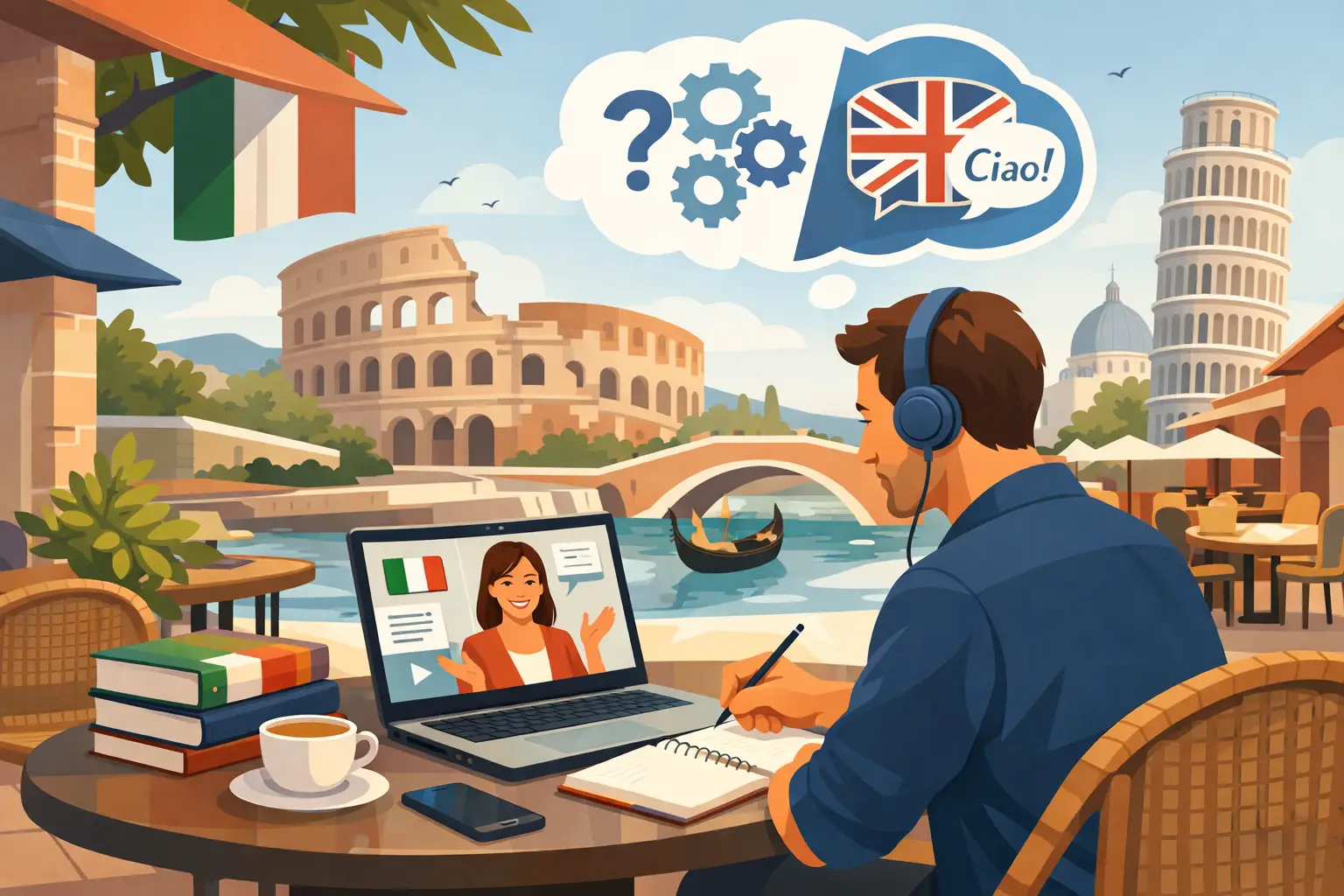
A student walks into a café in Rome, hears Buongiorno, cosa prende?, and realizes they understand the rhythm but not every word. That moment captures the honest answer to is Italian hard for English speakers: it is challenging enough to be interesting, but far more approachable than many learners expect.
For English-speaking adults, Italian has several early advantages: familiar words, consistent spelling, and pronunciation that becomes reliable quickly. The harder parts tend to appear when you move beyond ordering a coffee and begin expressing opinions, telling stories, or following a fast conversation among native speakers. The good news is that these are learnable skills, not signs that you are “bad at languages.”
Why Italian Often Feels Easier at the Start
Italian and English do not come from the same language branch, but English has borrowed extensively from Latin and French. As a result, many Italian words look reassuringly familiar. Nazione, importante, università, famiglia, and problema are not difficult to recognize. Even when the words are not identical, the connection can help you build vocabulary faster.
Pronunciation is another major advantage. Italian spelling is comparatively consistent: once you learn the sound patterns, you can usually read a new word aloud with reasonable accuracy. English speakers are used to far less predictability. Think of the different sounds in “though,” “through,” and “tough.” Italian does have details to master, particularly double consonants and the sounds of gli and gn, but it does not make you guess at every word.
For example, pala means shovel, while palla means ball. The doubled l changes the word, so it matters. But the rule itself is clear: hold the consonant a little longer. This is much easier to practice than trying to memorize a long list of irregular spelling-pronunciation combinations.
Is Italian Hard for English Speakers Beyond Beginner Level?
This is where the answer becomes more nuanced. Italian is not usually hard because of one impossible feature. It becomes demanding because several new habits need to work together in real time.
Grammar asks you to notice more
Italian nouns have grammatical gender, and adjectives need to agree with the noun. You say un ragazzo italiano for an Italian boy and una ragazza italiana for an Italian girl. English does not require this kind of agreement, so beginners can feel as if every sentence has extra moving parts.
Verb conjugations also carry more information than English verbs. Instead of relying heavily on subject pronouns, Italian changes the verb ending:
Parlo italiano means “I speak Italian.” Parli italiano means “You speak Italian.” Parliamo italiano means “We speak Italian.”
At first, that can look like a lot to memorize. Yet it also gives Italian a useful logic. Once you recognize endings, you can often tell who is doing the action even when the pronoun is omitted.
The real challenge is not memorizing one chart. It is retrieving the right form while you are listening, thinking, and responding. Adult learners often know the grammar on paper before they can use it comfortably in conversation. That gap is normal.
Small words cause surprisingly big problems
Articles and prepositions are often more difficult than dramatic grammar topics. Learners may understand vado means “I go,” but hesitate over vado a Roma, vengo da Roma, or sono in Italia. Italian uses these small words in patterns that do not always match English.
Then there are combined forms such as nel, sul, and alla, along with pronouns like mi, ti, gli, and ne. These become natural through repeated exposure and guided speaking, not by trying to solve every sentence as a grammar puzzle.
Listening is usually the turning point
Clear textbook Italian and everyday Italian are not the same experience. Native speakers link sounds, shorten familiar expressions, interrupt gently, and speak with regional accents. A learner who can read a dialogue may still struggle to catch it at normal speed.
Daniele and Anna often see this with adult students who have studied independently for months. They have built vocabulary and completed exercises, but they have had little practice hearing Italian used spontaneously. The solution is not to wait until you “know enough” to listen. It is to listen early, with material that is understandable and repeated often.
What Makes Italian Easier or Harder for You?
Your goal matters. Learning enough Italian to greet relatives, order meals, ask directions, and enjoy a trip is a very different project from preparing for an Italian university program or leading business meetings in Milan.
Heritage learners may recognize sounds and expressions from childhood but need help organizing grammar and building confidence. Travelers may progress quickly with practical phrases but need more listening practice to handle unexpected questions. Professionals often need precise vocabulary and polite register. No single definition of “hard” fits every learner.
Your study routine matters too. Two focused hours a week that include speaking and review will take you further than occasional bursts of app practice. Consistency gives your brain time to recognize patterns. Conversation gives those patterns a purpose.
The Skills Worth Prioritizing First
A common mistake is trying to learn every tense before attempting a real exchange. Instead, start with the language that lets you participate in daily life: introductions, preferences, simple questions, numbers, time, directions, and common reactions.
A short exchange can carry a lot of useful Italian:
A: Che cosa fai questo weekend? B: Sabato lavoro, ma domenica vorrei andare al mare. A: Che bello! Con chi vai? B: Vado con alcuni amici.
This small conversation practices question words, present tense, the conditional vorrei (“I would like”), time expressions, and a common preposition. More importantly, it sounds like something people might actually say.
As you build from there, focus on three habits. First, learn useful phrases as complete chunks, such as secondo me (“in my opinion”) or non vedo l’ora (“I can’t wait”). Second, say sentences aloud, even when studying alone. Third, return to familiar audio until it feels easier. Repetition is not boring when you can hear your understanding grow.
A Realistic Path to Conversational Confidence
Italian rewards learners who combine structure with regular exposure. Grammar gives you a map, but listening and speaking teach you how people actually travel on the road.
In a class, it helps to work with a native teacher who can hear the difference between an understandable sentence and a natural one. Small corrections are valuable: perhaps you said io sono 30 anni instead of ho 30 anni, or translated an English phrase word for word. These are ordinary stages of learning, and they are much easier to fix in a supportive conversation than in silence.
At The Italian Lesson, this is why lessons balance explanations with speaking practice, authentic materials, transcripts, and exercises. A clear grammar point is useful, but it becomes memorable when you use it to talk about your week, react to a story, or ask a classmate a genuine question.
Do not measure progress only by how many rules you can recite. Notice when you can understand a voice message, respond without translating every word, or recover after forgetting a term. Those are the moments when Italian stops being a subject and starts becoming a language you can live in.
Frequently Asked Questions
How long does it take an English speaker to learn Italian?
It depends on your starting point, schedule, and goal. Basic travel conversations can develop within months of consistent study, while comfortable conversation requires longer-term practice. Regular speaking and listening usually matter more than studying in occasional marathon sessions.
Is Italian easier than Spanish for English speakers?
Both are accessible choices for English speakers and share many Romance-language features. Some learners find Italian pronunciation more predictable, while others encounter Spanish more often and therefore get more passive exposure. The better choice is usually the language you feel motivated to use regularly.
Is Italian grammar harder than English grammar?
Italian grammar has more verb forms, noun gender, and agreement than English. However, it is also more consistent in several areas, especially pronunciation and many verb patterns. It may feel unfamiliar at first rather than inherently harder.
Can I learn Italian if I am older?
Yes. Adult learners bring discipline, life experience, and a clear reason for learning. You may need patience with recall and pronunciation, but you can make strong progress with a routine that includes active speaking, listening, and review.
What is the hardest part of learning Italian?
For many English speakers, understanding fast natural speech and using grammar automatically in conversation are the hardest stages. They improve through repeated listening, guided correction, and regular opportunities to respond in Italian.
Italian will ask you to be comfortable making imperfect sentences for a while. Keep showing up for those small conversations, because each one gives you another piece of the language that no verb chart can provide.