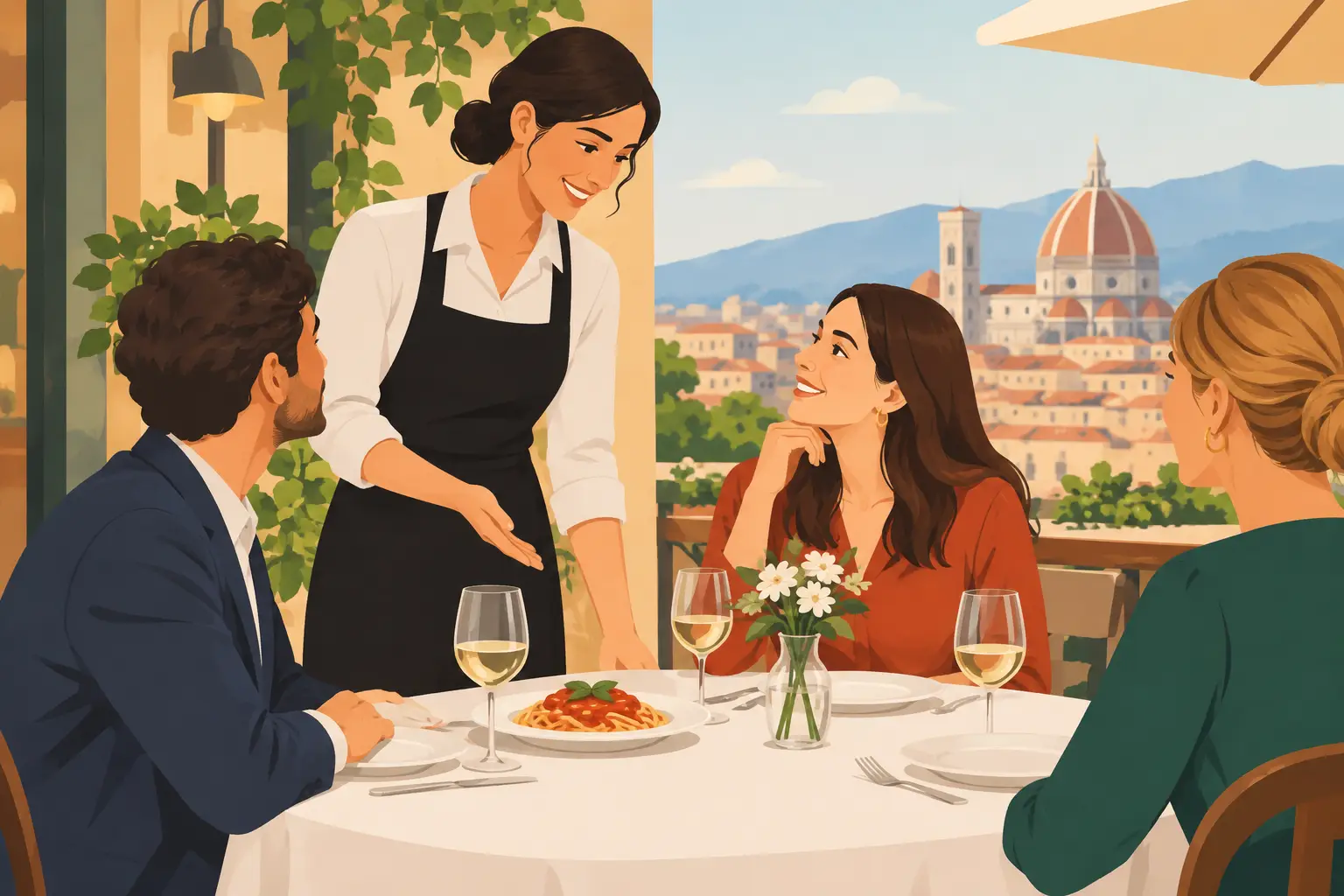
The moment the server asks, Avete prenotato? – “Do you have a reservation?” – Italian restaurant etiquette becomes more than knowing which fork to use. It is about reading the pace of the meal, speaking with a little courtesy, and understanding that lunch or dinner is often meant to be enjoyed rather than rushed. For Italian learners, a restaurant is also one of the best real-life classrooms: you hear everyday questions, polite requests, and the small expressions that textbooks can overlook.
Italian Restaurant Etiquette Starts Before You Sit Down
In Italy, reservations are common, especially for dinner, weekends, and popular places. Arriving exactly on time is appreciated. A few minutes late is usually not dramatic, but calling ahead is a thoughtful gesture if you know you will be delayed.
When you enter, do not assume you should choose a table. Wait to be greeted or say, Buonasera, abbiamo una prenotazione a nome Smith. This means, “Good evening, we have a reservation under the name Smith.” If you do not have one, try: Avete un tavolo per due? – “Do you have a table for two?”
Daniele often reminds students that politeness in Italian does not require elaborate language. A clear greeting, per favore, and grazie go a long way. In a casual trattoria, the tone may be warm and informal. In a more formal restaurant, staff may use Lei, the polite form of “you.” Follow their lead, but do not worry about getting every detail perfect.
Understanding the Rhythm of an Italian Meal
A menu may be divided into antipasti, primi, secondi, contorni, and dolci. These categories describe courses, not rules that every diner must follow. You can order only a pasta dish, share an appetizer, or choose a main course and a side dish. The key is to understand what you are ordering.
A primo is often pasta, risotto, soup, or another first course. A secondo is usually meat, fish, eggs, or a substantial vegetarian dish. Vegetables and potatoes are frequently ordered separately as contorni. This surprises many American visitors, who may expect a main dish to arrive with vegetables already included.
There is also no obligation to order a complete multi-course meal. If you want pasta and a glass of wine, that is perfectly normal. If you are uncertain, ask: Come funziona il menù? – “How does the menu work?” Or, more simply: Che cosa mi consiglia? – “What do you recommend?”
One small cultural point: cappuccino is traditionally a breakfast drink. Ordering one after dinner may mark you as a visitor, but it is not a serious breach of etiquette. Italians are not waiting to police your coffee choice. Still, after a meal, un caffè usually means a small espresso. If you want American-style coffee, ask for caffè americano.
Ordering Politely Without Sounding Too Formal
You do not need advanced Italian to order well. A few reliable structures will make you sound considerate and confident.
You can say, Prendo gli spaghetti alle vongole, literally “I’ll have the spaghetti with clams.” For a more polite request, use Vorrei… – “I would like…” For example: Vorrei il risotto ai funghi, per favore.
If you have a dietary need, be direct and specific. Sono vegetariano/a means “I am vegetarian.” Sono allergico/a alle noci means “I am allergic to nuts.” For gluten intolerance, say: Sono celiaco/a. Questo piatto contiene glutine? Restaurants vary greatly in how they handle allergies, so asking clearly matters more than trying to be easygoing.
Anna tells her students not to translate every English restaurant phrase word for word. In English, “Can I get…?” is natural. In Italian, Posso avere…? is understandable, but Vorrei… or Prendo… usually sounds more natural when ordering. These are small choices, yet they help you participate in the exchange rather than recite a memorized script.
A short restaurant dialogue
Server: Siete pronti per ordinare? You: Sì, vorrei le lasagne, per favore. E per lui, il pollo alla griglia. Server: Da bere? You: Una bottiglia d’acqua naturale e due bicchieri di vino rosso, grazie.
Notice that acqua naturale is still water and acqua frizzante is sparkling water. Unless you specify, the server may ask which you prefer.
Bread, Cheese, and Other Small Customs
Italian meals have local habits, and Italy is far too diverse for one universal rulebook. Still, a few customs are useful to know. Bread may be served without butter and is generally intended for the meal, not as a pre-dinner snack. It is normal to use it to collect sauce left on your plate, a practice called fare la scarpetta. In a relaxed setting, especially when the meal is nearly finished, it is widely accepted. In a very formal restaurant, it may be better to observe what others do.
Cheese is another case where context matters. Parmesan is not automatically offered with every pasta dish, particularly seafood pasta. If you would like cheese, ask politely: Posso avere del parmigiano? If the answer is no, take it as a pairing choice rather than a personal correction.
Americans are sometimes taught that cutting pasta with a knife is forbidden. In reality, manners are rarely that dramatic. Long pasta is normally twirled with a fork, and many Italians do not use a spoon to assist. But if a child needs help, or you are struggling with a slippery plate of spaghetti, no one’s evening will be ruined. Good etiquette is largely about consideration, not performance.
Paying the Bill and Tipping in Italy
When you are ready to pay, asking for the check is not rude. You can say, Il conto, per favore. In most restaurants, the server will not bring it until you ask. Lingering after the meal is normal, especially at dinner, and staff are less likely to rush you than in many US restaurants.
Check the bill for coperto, a per-person cover charge that may cover bread, table service, and place settings. It is legal and common in many areas. You may also see servizio incluso, meaning service is included.
Tipping is not structured like it is in the United States. A large percentage tip is not expected. People may round up, leave a few euros for particularly attentive service, or leave nothing extra when service is already included. Let the setting guide you: a quick lunch at a neighborhood bar and a long dinner with excellent table service are different situations.
If you are splitting the bill, ask, Possiamo pagare separatamente? – “Can we pay separately?” Some restaurants can do this easily; others prefer one payment. Asking politely before the bill is prepared gives the staff more flexibility.
A Quick Practice Before Your Next Meal
Try completing these mini-dialogues aloud. The goal is not grammatical perfection. It is getting comfortable enough to use the phrases when a server is standing in front of you.
- You want a table for four without a reservation: Buonasera, avete un tavolo ___ quattro?
- You want sparkling water: Per favore, una bottiglia d’acqua ___.
- You need to ask whether a dish contains dairy: Questo piatto contiene ___?
- You are ready to leave: Il ___, per favore.
Answer key
- per
- frizzante
- latticini
- conto
Frequently Asked Questions About Italian Restaurant Etiquette
Is it rude to ask for substitutions at an Italian restaurant?
Not necessarily, especially for allergies, dietary restrictions, or a simple preference. But Italian dishes are often designed around a specific combination of ingredients, so extensive changes may not be possible. Ask rather than assume: È possibile senza cipolla? – “Is it possible without onion?”
Should I tip at restaurants in Italy?
You do not need to follow the US model of percentage-based tipping. Check whether servizio is included, and feel free to round up or leave a small amount for excellent service. A sincere grazie mille is always welcome too.
Can I order only pasta in Italy?
Yes. You can order one course, two courses, or a full meal. A primo on its own is a normal lunch or light dinner choice.
Is it okay to ask for tap water in Italy?
You can ask, but many restaurants serve bottled water rather than free tap water. Say acqua del rubinetto if you want to ask for tap water, and accept the answer graciously if it is not offered.
What should I say when leaving an Italian restaurant?
A simple Grazie, buona serata – “Thank you, have a good evening” – is ideal. At lunch, use buona giornata. These final words are small, but they leave a warm impression.
The best restaurant Italian is not a flawless performance. It is the confidence to greet people, ask a clear question, enjoy the food at the table’s pace, and respond with warmth. Learn a handful of phrases well, then use them the next time you sit down for a meal. That is where the language begins to feel like yours.