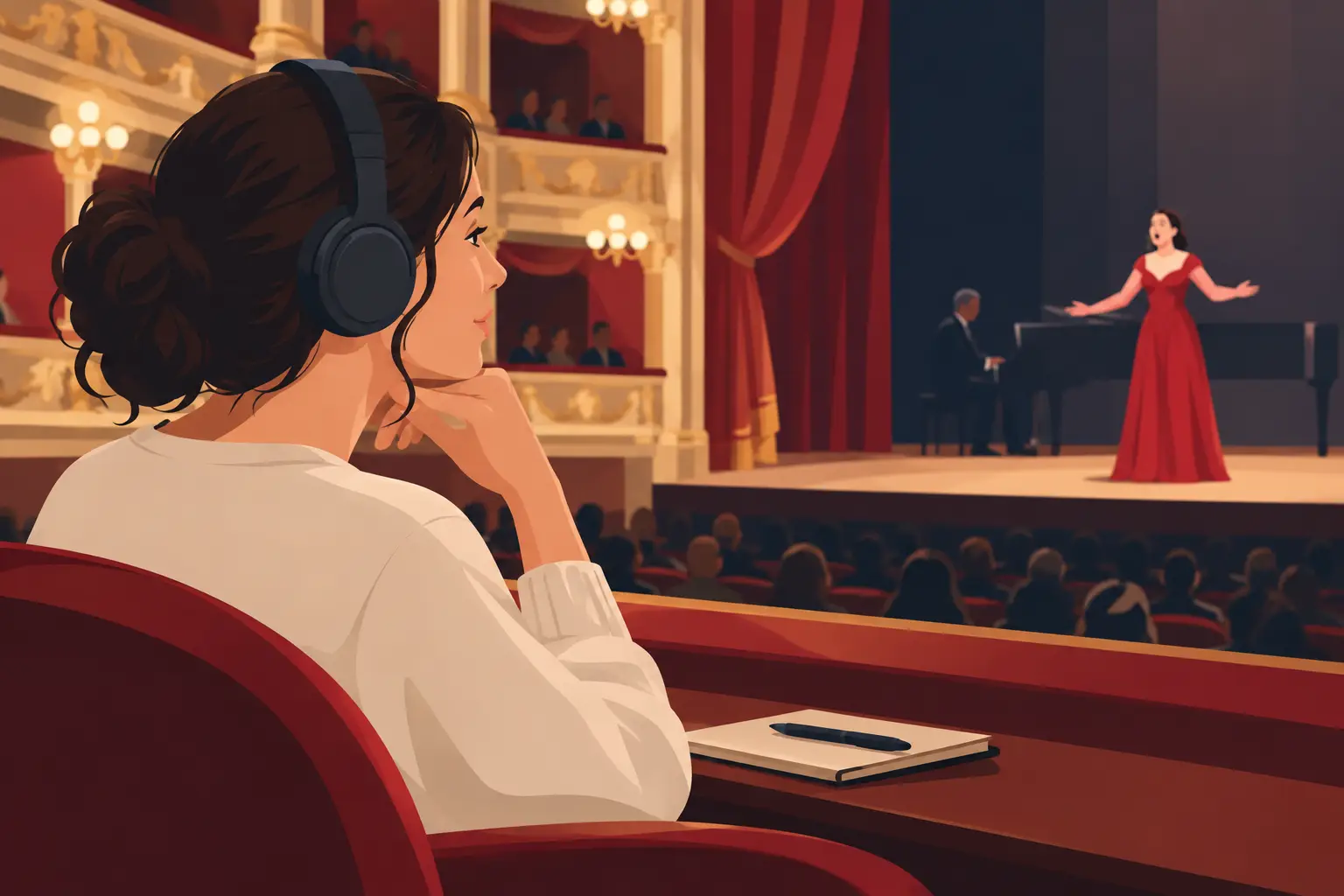
When the conductor raises the baton and the first notes begin, you do not need to understand every Italian word to feel opera. But an Italian opera vocabulary guide can turn that emotional experience into a more meaningful one. You start recognizing who is singing, what kind of musical moment you are hearing, and why one short phrase can make an audience hold its breath.
For many adult learners, opera is also a wonderful reason to study Italian. The language is expressive, rhythmic, and full of familiar words that appear in music, theater, and everyday conversation. The key is to learn the terms as living language, not as a museum list of labels.
The essential Italian opera vocabulary guide
Italian shaped the vocabulary of Western classical music, so you will see Italian words even at an opera in New York, London, or Vienna. Some terms describe the people on stage; others tell musicians how to play. Begin with the words that help you understand the performance itself.
An opera is the complete work: story, music, singers, orchestra, costumes, and staging. A libretto is the opera’s text, usually written by a librettist. Think of it as the script, although its words are designed to be sung.
The orchestra plays in the buca d’orchestra, the orchestra pit. The person leading the musicians and singers is the direttore d’orchestra, or conductor. On stage, the singers perform characters called personaggi.
Before a performance, you may hear someone say, L’opera inizia alle otto, meaning “The opera starts at eight.” If there is a break, it is an intervallo. At the end, the audience may call for bis, literally “again,” when they hope to hear a piece repeated. This is less common in fully staged modern performances, but the word remains useful.
Aria, recitative, and ensemble
An aria is a solo piece in which a character expresses an emotion, a decision, or an inner conflict. It is often the musical moment people remember after the curtain falls. In Puccini’s La bohème, Rodolfo’s “Che gelida manina” is an aria.
A recitativo, or recitative, moves the plot forward in a more speech-like way. It can feel less immediately memorable than an aria, but it is where you often learn what has changed in the story. A duetto is for two singers, a terzetto for three, and an ensemble brings several characters together. When everyone sings different thoughts at once, the drama can become wonderfully chaotic.
The coro is the chorus. Depending on the opera, it may represent townspeople, soldiers, guests at a party, priests, or a crowd reacting to the main characters. In Italian, il coro is singular, even though it refers to many singers.
Voice types you will hear
Voice labels are practical, not judgments of quality. They describe range, color, and the kinds of roles a singer may perform. A soprano is usually the highest common female voice; a mezzosoprano generally has a lower, richer range; and a contralto is lower still and comparatively rare.
Among male voices, a tenore sings higher, a baritono occupies the middle range, and a basso sings the lowest. Opera traditions often connect these voices with certain character types, but there are many exceptions. A tenor may be the romantic lead, while a baritone may be a rival, father, friend, or villain. The story decides more than the label does.
You may also see prima donna, literally “first lady,” for a leading female singer or role. Its modern English meaning can sound critical, but in opera it began as a professional designation. The male equivalent is primo uomo, though it is less common in everyday English discussion of opera.
Daniele often reminds students that words such as soprano and tenore are easy to recognize but can be hard to pronounce naturally. Keep the final vowel clear: so-PRA-no, te-NO-re, ba-ri-TO-no. Italian vowels do not fade away at the end of a word.
Musical directions worth recognizing
Italian musical directions can look intimidating on a program or score, but many are descriptive words you can learn in context. Piano means softly, while forte means loudly or strongly. Pianissimo means very softly, and fortissimo means very loudly.
Tempo words describe speed and mood. Allegro usually suggests a fast, lively pace. Adagio is slow and expressive. Andante means “walking,” so it often feels like a moderate, flowing pace. Presto means very fast.
A few terms are especially useful because their everyday meanings still exist in Italian. Dolce means sweetly. Con brio means with spirit or energy. A cappella means without instrumental accompaniment. Crescendo means gradually growing louder, while diminuendo means gradually becoming softer.
Anna points out that these words are a useful bridge between language study and listening. If you know that dolce also means “sweet,” you can hear the instruction as an image rather than a technical code. That kind of connection helps vocabulary stay with you.
Words for following the story
Opera plots can involve love, jealousy, political power, family loyalty, comedy, and loss. These Italian words appear often in synopses and subtitles:
- amore – love
- cuore – heart
- vita – life
- morte – death
- sogno – dream
- addio – goodbye
- tradimento – betrayal
- vendetta – revenge
Notice how many are familiar to English speakers through music and literature. Still, do not assume every familiar-looking word works exactly like English. Camera, for example, means “room,” not a device for taking photographs. Context matters, especially in older libretti, where word order and poetic language may sound different from modern conversation.
Here is a small example. Addio, mio cuore means “Goodbye, my heart” or “Farewell, my love.” It is dramatic language. You would not normally say it when leaving a colleague after a meeting, unless you are deliberately joking.
Opera Italian is not everyday Italian
This distinction can save learners frustration. Opera exposes you to beautiful Italian, but it is not always the Italian you will use when ordering coffee or chatting with friends. Libretti may use formal address, literary vocabulary, inverted word order, and repeated phrases shaped by music.
For example, Io ti amo means “I love you,” but a libretto may place words in a less usual order to fit the melody. You may also hear amor instead of amore. This shortened form is poetic, not a mistake.
That does not make opera irrelevant to spoken Italian. It trains your ear for vowel sounds, double consonants, emotion, and phrasing. Use it alongside contemporary Italian, rather than treating it as your only model. If your goal is conversation, repeat short lines for pronunciation, then learn how you would express the same idea naturally today.
Practice: listen, notice, say it aloud
Try these short exercises before your next opera recording or performance.
1. Choose the right word
Complete each sentence with aria, coro, or libretto.
- The written text of an opera is the ________.
- A solo song for one character is an ________.
- The group of singers representing the crowd is the ________.
2. Match the direction to its meaning
Match piano, presto, and dolce to: softly, very fast, sweetly.
3. Make it conversational
An opera character sings, Addio, mio cuore. Imagine you are leaving a friend after dinner. What would you say instead? Try: Ciao, ci vediamo presto! (“Bye, see you soon!”)
Answer key: 1. libretto, 2. aria, 3. coro. For exercise 2: piano = softly, presto = very fast, dolce = sweetly. Exercise 3 has several natural answers, including Ciao, a presto! or Buona serata!
Frequently asked questions
Do I need to speak Italian to enjoy Italian opera?
No. Subtitles and a short plot summary can help you follow the story, while the music communicates a great deal on its own. Knowing some Italian makes repeated listening more rewarding, especially when you begin to recognize words and emotional cues.
What are the most useful Italian opera words for beginners?
Start with aria, coro, libretto, soprano, tenore, piano, forte, and intervallo. Then add a few story words such as amore, cuore, and addio. These give you a strong foundation without turning your listening into homework.
Is opera Italian difficult to understand?
Often, yes. Singing stretches vowels, orchestration can cover consonants, and libretti may use poetic language. Even native Italian speakers do not catch every word without reading the text. Use subtitles without guilt.
How can I improve Italian pronunciation through opera?
Choose one short, slow phrase and listen several times. Read it aloud, paying attention to every vowel, then imitate the singer’s rhythm without forcing their dramatic style. A teacher can help you separate useful pronunciation practice from theatrical vocal technique.
Are musical terms like allegro and adagio still used in Italian?
Yes, but their everyday use is narrower than their musical use. Allegro can mean cheerful, and adagio means slowly. In music, both terms carry more specific conventions about pace and expression.
The next time an aria stops you in your tracks, pause before looking up the translation. Listen once for the feeling, then find one or two words you can recognize and say aloud. That small habit turns opera from something you admire at a distance into another place where Italian starts to feel like yours.