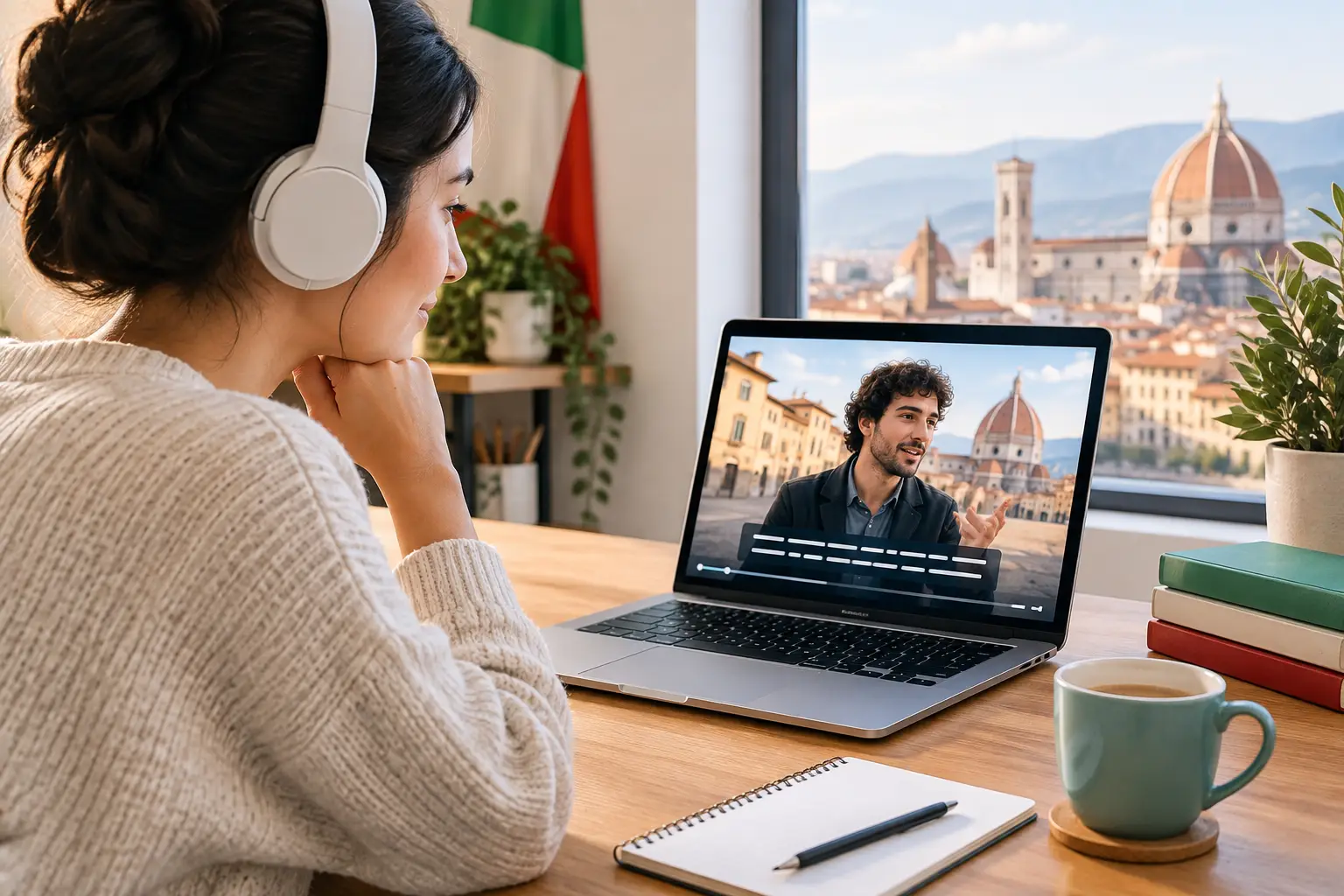
A scene moves quickly: two friends interrupt each other, someone mutters mah, and the joke lands before you have finished translating the first sentence. This is where Italian subtitles can change the experience. Used well, they are not a crutch or a shortcut. They are a bridge between the Italian you can read, the Italian you can hear, and the Italian you want to speak.
Many adult learners watch Italian films or series with English subtitles and feel entertained but unchanged as speakers. Others switch immediately to Italian subtitles and feel lost. Both reactions are normal. The useful approach sits in the middle: choose material at the right level, work with short sections, and use subtitles to notice how real Italians connect words and express ideas.
Why Italian subtitles help more than English ones
English subtitles tell you what a line means. Italian subtitles show you how that meaning was built. They let you connect a sound to its spelling, notice familiar grammar in context, and see useful phrases as complete chunks rather than isolated vocabulary.
For example, you may hear something that sounds like cce l’ho, then see ce l’ho on screen. Suddenly, the phrase has a shape. In context, Ce l’ho! may mean “I have it!” or “I’ve got it!” The small words are easy to miss in fast conversation, but subtitles make them visible.
They also reveal a truth that grammar books cannot fully capture: spoken Italian is often compact. A character may say, Che ne so?, literally “What do I know about it?” but naturally meaning “How should I know?” Or they may reply, Ci penso io, meaning “I’ll take care of it.” These are the expressions that make a learner sound more natural in conversation.
Daniele often reminds students that understanding every word is not the first goal. The goal is to follow the situation, recognize recurring language, and gradually tolerate the moments you do not understand. Italian subtitles support that process because they give your ear a second chance without replacing Italian with English.
The right way to use Italian subtitles
The best method depends on your level and the material. A beginner watching a fast crime drama needs a different strategy from an upper-intermediate learner watching a relaxed interview. In both cases, avoid treating an entire two-hour film as a study session. A short scene of one to three minutes gives you far more usable practice.
Start with a scene you can mostly follow
Choose content with a clear setting and visible action: a family dinner, a café conversation, a workplace exchange, or a simple interview. If possible, begin with a program you already know in English. Familiarity lowers the pressure and leaves more attention for the language.
Watch the scene once with Italian subtitles, without pausing. Do not chase every unknown word. Ask yourself: Who is speaking? What do they want? Is the mood friendly, impatient, embarrassed, or formal? Meaning comes from tone, facial expression, and context as well as vocabulary.
Then watch it again and pause only at lines that are useful or repeated. Write down two or three expressions you could genuinely use. That limit matters. A notebook full of single words is less valuable than a few phrases you can say comfortably.
Listen before you read
On the next viewing, cover the subtitles briefly with your hand or turn them off for a few seconds at a time. Listen for words you already noticed. Then reveal the subtitles and check what you caught.
This small habit prevents reading from taking over. Your long-term aim is not to become a faster Italian reader. It is to train your ear to recognize Italian at normal speed.
Anna sees a common pattern in lessons: students understand a phrase immediately when they see it written, yet do not recognize it when a native speaker says it. The gap is often about sound, not grammar. Subtitles help close it when learners replay short sections and listen for the linking and rhythm of the sentence.
Repeat whole phrases aloud
Choose one line and repeat it several times, copying the speaker’s rhythm rather than performing each word separately. This is especially helpful with small expressions that carry conversation forward:
- Non ne ho idea. – “I have no idea.”
- Figurati! – “Don’t mention it,” “of course,” or “no problem,” depending on context.
- Magari! – “I wish!” or “If only!”
Notice that the subtitle may be a little different from what you hear. Subtitles are usually edited for reading speed and clarity, so they may shorten repetitions, soften hesitation, or omit a filler such as eh. That is not a problem. Treat subtitles as a helpful transcript, not a perfect record of every sound.
What to watch for in real Italian
Italian subtitles are particularly useful for noticing register. The Italian used between close friends is not the same as the language used with a professor, a client, or an older neighbor. A series can show you the difference naturally.
Listen to how characters make requests. Mi passi il sale? is an informal “Can you pass me the salt?” At a restaurant, Potrebbe portarmi il conto, per favore? is more formal: “Could you bring me the bill, please?” Both are correct, but they fit different relationships and settings.
Pay attention to regional and generational variety, too. Italy does not have one single everyday Italian. You may hear local accents, regional vocabulary, or expressions that are common among younger speakers but not in a business meeting. You do not need to copy every phrase. The value is learning to recognize variation and choose language that fits your own situation.
A 15-minute subtitle routine
Try this with one short clip three times a week. First, watch once with Italian subtitles and identify the main situation. Next, replay it in small sections and collect up to three useful phrases. Finally, listen again with subtitles off and repeat one line aloud until it feels smooth.
Finish by making the language personal. If the character says, Non ne ho idea, answer a real question with it: Sai dov’è il mio caricatore? – Non ne ho idea. If the phrase cannot enter your own life, it is less likely to stay with you.
Mini practice
Read these subtitle-style lines and choose the response that sounds most natural.
- Hai già prenotato il tavolo?
a) Sì, ce l’ho. b) Sì, l’ho già prenotato. c) Sì, ne sono.
- Ti va un caffè dopo lavoro?
a) Volentieri! b) Mi va il lavoro. c) Ho un caffè.
- Correct the sentence: Io non ho idea di questo.
- Make this more polite for a hotel reception: Dammi una camera tranquilla.
Answer key: 1) b. You book a table, so l’ho già prenotato is the natural answer. 2) a. Volentieri! means “Gladly!” 3) Non ne ho idea or Non ne so nulla, depending on the context. 4) Potrebbe darmi una camera tranquilla, per favore?
When English subtitles still make sense
English subtitles are not forbidden. They can be useful when the plot is complex, the topic is emotionally demanding, or you are watching for enjoyment with friends or family. They are also helpful for a first viewing when the material is far above your level.
Just do not let English be the final step. If a scene matters to you, return to a short section later with Italian subtitles. Even five focused minutes can turn passive viewing into language practice.
Frequently asked questions about Italian subtitles
Should beginners use Italian subtitles?
Yes, but with short, accessible clips. Beginners should not expect to understand everything. Start with familiar situations and focus on recognizing greetings, common verbs, and repeated phrases.
Are Italian subtitles better than Italian captions?
People often use the terms interchangeably. In practice, subtitles may be adapted from dialogue, while captions can include sound descriptions. For language learning, either can help, as long as the spoken Italian and written text are close enough to compare.
Will Italian subtitles improve my speaking?
They can, if you speak back. Reading alone improves recognition. Repeating short lines, copying intonation, and using expressions in your own mini-dialogues turns recognition into active language.
What if I read subtitles but cannot understand the audio?
Slow down and work with a shorter clip. Listen once, read once, then listen again. Your ear needs repeated exposure to the same sounds before it begins to recognize them automatically.
How many new words should I learn from one scene?
Two or three useful phrases are enough. Choose expressions you are likely to use, not every unfamiliar word you see. Consistent review matters more than collecting a long list.
Italian subtitles work best when they lead you back to people: the person speaking on screen, the person you will speak with next, and the version of yourself that can respond without translating every sentence. Choose one short scene this week, listen closely, borrow one phrase, and make it yours.