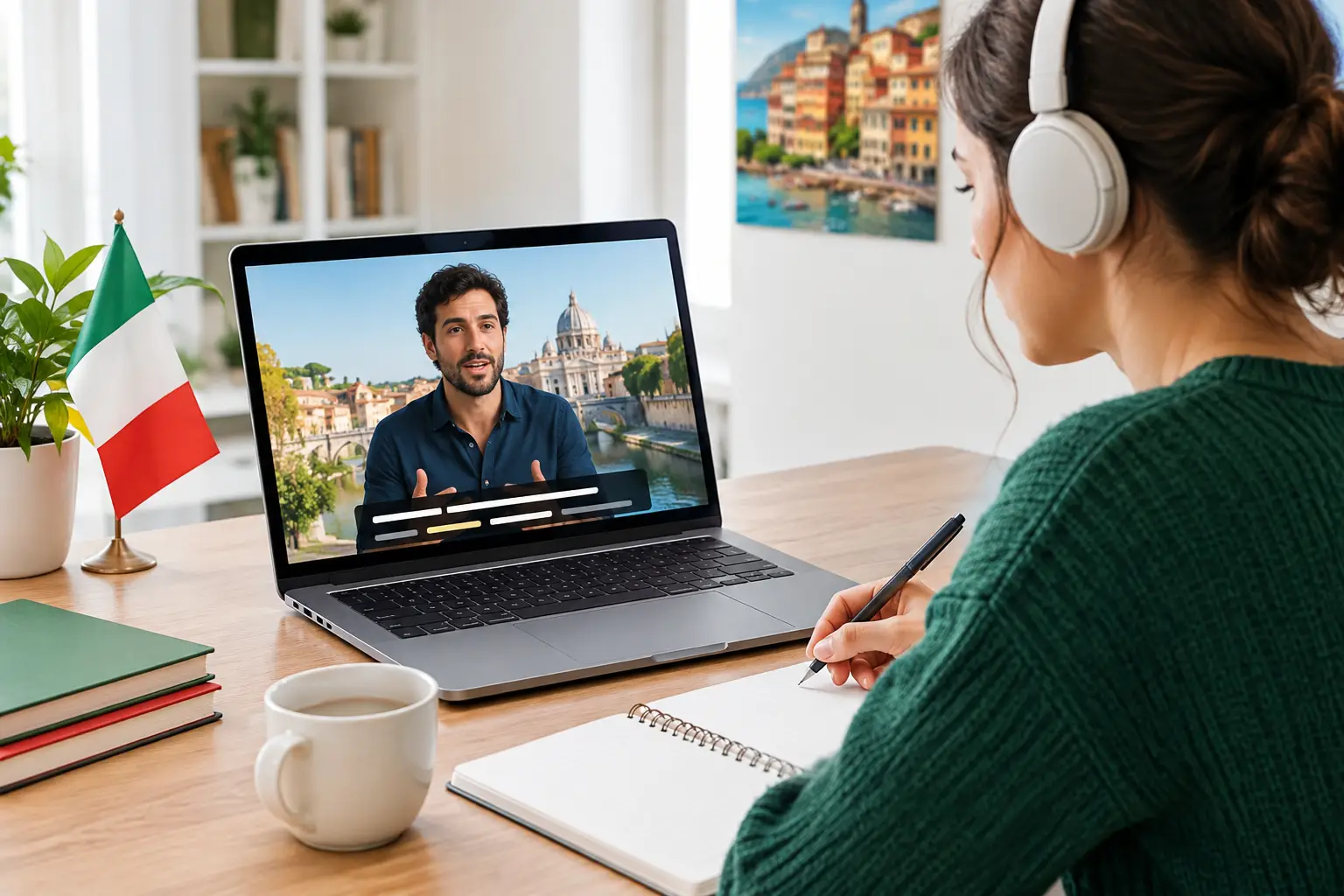
A student once told us that she could follow an Italian series perfectly – until she turned the subtitles off. That is not a failure. It is a useful clue. Can subtitles improve Italian? Absolutely, but only when you treat them as support for listening, not as a replacement for it.
For adult learners, subtitles can make authentic Italian feel less overwhelming. They show where one word ends and another begins, reveal familiar grammar inside fast speech, and give you a way to notice expressions you may miss in a textbook. Used passively, though, they can train your eyes to work harder than your ears.
Can subtitles improve Italian listening skills?
Yes, especially when the subtitles are in Italian. Spoken Italian has a rhythm that surprises many learners. Words join together: che cosa hai fatto? may sound closer to cos’hai fatto?; non lo so can be delivered so quickly that it feels like one short sound. Italian subtitles let you connect that sound to its written form.
Daniele often sees this in lessons with intermediate students. They know the words magari, allora, and cioè, but do not recognize them in a natural conversation because native speakers use them quickly and repeatedly. Seeing the phrase on screen gives the learner a second chance to catch it. Hearing it again soon afterward is what helps it become familiar.
The benefit is not limited to vocabulary. Captions make small, high-frequency grammar visible: pronouns such as mi, ti, and ci; contracted forms such as l’ho visto; and common past tenses. You begin to notice how Italians actually build sentences in conversation, rather than only how sentences look in an exercise.
There is one condition: choose material you can mostly follow. If you understand only a few isolated words, subtitles become a reading task and the listening benefit is limited. A short interview, a scene from a familiar show, or a graded video with a transcript is usually more productive than a fast, complicated film.
Italian subtitles versus English subtitles
English subtitles have a role, particularly for beginners. They can help you stay engaged with a story and understand the general situation. But they usually pull attention away from Italian. Your brain naturally chooses the language that requires less effort.
Italian subtitles ask more of you, and that is precisely why they are valuable once you know some basic Italian. You are matching Italian sound with Italian meaning. If you see Mi sa che arriva tardi, you can hear the phrase, notice the structure, and infer that it means something like, “I think he or she will arrive late.” It is more useful than seeing only the English translation.
Anna’s advice to learners is simple: do not make this an all-or-nothing rule. If a scene matters and you are completely lost, check English subtitles briefly or look up a key phrase. Then return to Italian captions. The goal is comprehension with growing independence, not proving that you can struggle through everything alone.
A better way to watch with subtitles
One viewing is rarely enough to turn a new expression into language you can use. A short clip of one to three minutes works better than an entire episode when your goal is learning. Watch it first with Italian subtitles and focus on the broad meaning. Do not pause for every unknown word.
On the second viewing, pause only for phrases that are useful, repeated, or confusing. Write down a small number of complete chunks, not a long list of single words. For example:
- Che ne pensi? – What do you think?
- Non ne ho idea. – I have no idea.
- Ci penso io. – I’ll take care of it.
Then play the clip again without subtitles. You will not catch every syllable, but you may be surprised by how much more you recognize. Finally, say two or three lines aloud, copying the speed and intonation as closely as you can. This is not about sounding theatrical. It is a practical way to make the phrase easier to retrieve in a real conversation.
A useful routine is to revisit the same clip the next day. If you can understand it without captions and use one phrase in your own sentence, it has done its job.
What subtitles can teach about real Italian
Subtitles are also a window into social language. In English, “okay” can cover agreement, hesitation, acceptance, or mild annoyance. Italian has several possibilities depending on tone and context: va bene, d’accordo, ok, ci sta, or simply eh.
A family comedy may show informal tu forms, teasing, and interruptions. A workplace scene may include Lei for formal address, polite softeners such as volevo chiederle, or the direct but friendly phrasing common among colleagues. These choices vary by region, generation, workplace, and relationship. Subtitles help you notice the exact words, while the scene helps you understand why they were chosen.
Be selective about what you copy. Dialogue can include slang, sarcasm, or language that fits one fictional character but not a conversation with your future in-laws or a university professor. Ask yourself: Who is speaking? To whom? Would this sound natural in my own situation? That habit builds not just vocabulary, but judgment.
Two short exercises to make captions active
Try these after watching any short Italian clip with captions.
Exercise 1: Listen, cover, and complete
Read the caption once, then cover it and listen again. Complete the phrase from memory:
- Che ___ pensi?
- Non ne ___ idea.
- Ci ___ io.
Exercise 2: Make it yours
Turn each expression into something you might genuinely say:
- Non ne ho idea – You do not know what time a store closes.
- Ci penso io – A friend is worried about booking a table.
- Che ne pensi? – You want a colleague’s opinion on a plan.
Possible answers: 1. Non ne ho idea, controllo online. 2. Ci penso io, prenoto per stasera. 3. Che ne pensi di questa idea? In Exercise 1, the missing words are ne, ho, and penso.
Common subtitle mistakes
The most common mistake is trying to translate every line. You will lose the scene, tire quickly, and remember very little. Let some unknown words pass unless they block the meaning or appear more than once.
Another mistake is keeping subtitles on forever. Captions are a bridge. Build regular moments without them, even if that means rewatching only thirty seconds. If you always read, you may feel confident while watching but freeze when someone speaks to you at normal speed.
Finally, do not confuse recognition with speaking ability. Understanding Mi sa che on screen is a good step. Using it naturally when you are making plans is the next one. This is where conversation practice with a teacher or a small group turns passive exposure into real communication.
Frequently asked questions
Should beginners use Italian subtitles?
Beginners can use them with very short, simple videos after learning basic pronunciation and common phrases. English subtitles may help with the first viewing, but try to return to Italian captions for familiar material. Start small rather than choosing a full-length movie.
Are subtitles good for learning Italian vocabulary?
Yes, when you save useful phrases in context and review them. A single word is easy to forget. A line such as Non vedo l’ora di partire gives you vocabulary, grammar, and a natural situation all at once.
Should I watch Italian TV with or without subtitles?
Use both. Watch first with Italian subtitles, then replay a short section without them. For a relaxing evening, subtitles are fine. For focused study, alternate them deliberately.
Why can I read Italian subtitles but not understand spoken Italian?
Reading gives you more control over speed, word boundaries, and spelling. Listening happens in real time, with connected speech and different accents. Repetition, shorter clips, and occasional subtitle-free listening close that gap gradually.
Do subtitles help Italian pronunciation?
They can, because they show the words you are hearing. But pronunciation improves most when you pause, repeat aloud, and compare your rhythm to the speaker’s. Pay attention to doubled consonants, open and closed vowels, and the musical rise and fall of the sentence.
Subtitles work best when they lead you back to the voices on screen. Use them to notice real Italian, replay what you missed, and borrow a few phrases you can use this week. Then give yourself the satisfying challenge of listening without them – one short scene at a time.