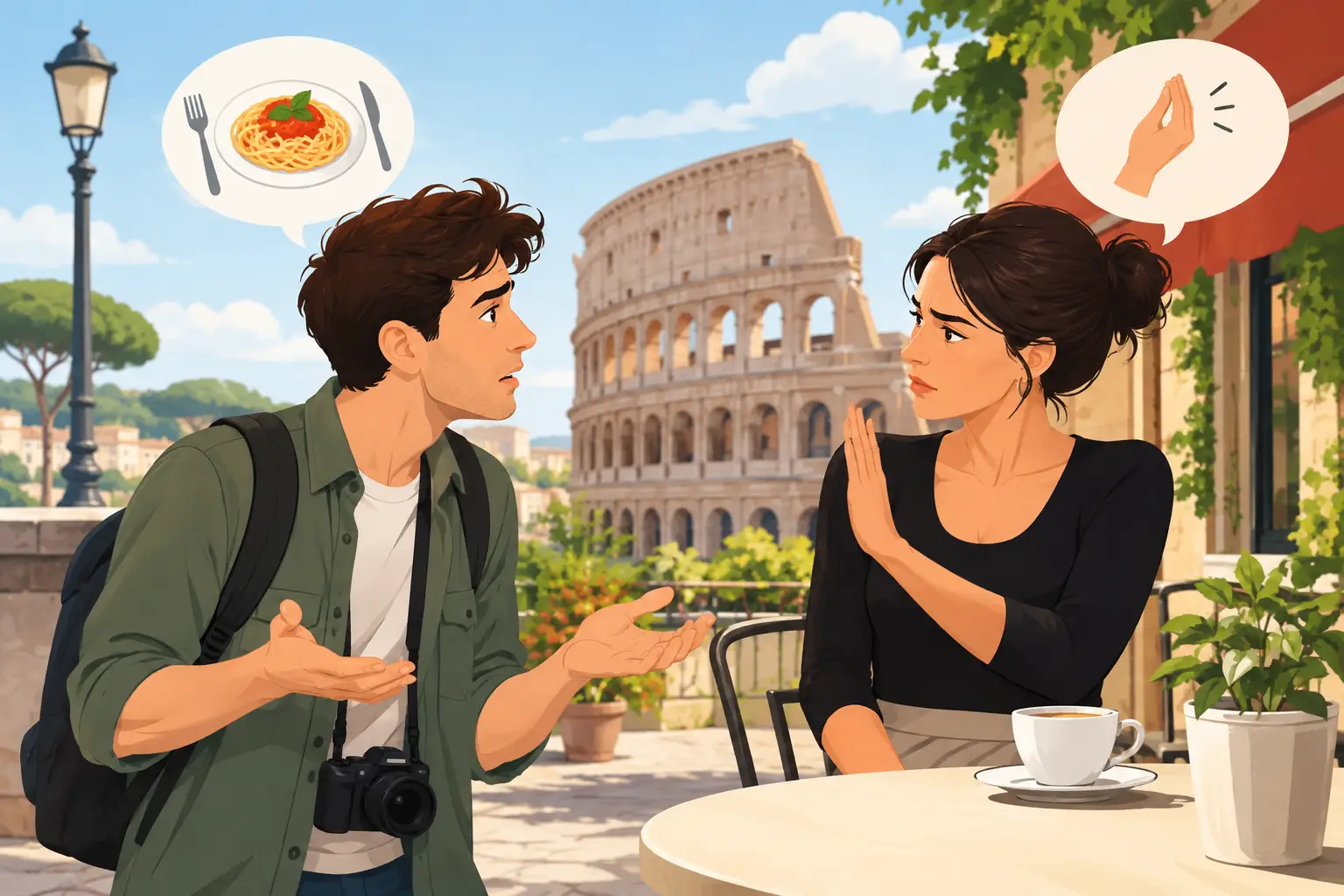
A student once told us she had made several Italian friends, but worried they were suddenly upset with her. The reason? They kept saying, Dai, ci vediamo presto! and she had taken every “Let’s meet soon!” as a fixed plan. This is one of the most common Italian cultural misunderstandings: the words are friendly and genuine, but they do not always mean an appointment has been made.
Learning Italian is not only about choosing the right verb tense. It is also about noticing what people mean through tone, timing, gestures, and shared expectations. Italy is diverse, and habits vary by region, age, workplace, and family. Still, a few patterns come up again and again in our classes. Understanding them will help you sound more natural and, more importantly, feel more relaxed when real conversations move beyond the textbook.
Italian cultural misunderstandings often begin with warmth
Many English-speaking learners are surprised by how quickly Italian interactions can feel personal. A cashier may call you cara or tesoro. A new acquaintance may ask about your family, relationship, or work within minutes. This is not automatically intrusive. Often, it is a way of creating connection.
At the same time, warmth does not mean that everyone has the same boundaries. In a professional meeting in Milan, for example, the conversation may be more reserved than at a Sunday lunch with relatives in Puglia. Context matters.
One useful distinction is between being friendly and being familiar. Italians may be warm early on, while still using formal language with people they do not know well. If you are speaking to an older person, a client, a professor, or someone in a formal setting, start with Lei rather than tu.
> Buongiorno, piacere di conoscerLa. > > Good morning, it is nice to meet you.
If the other person says, Diamoci del tu, they are inviting you to use the informal form. You do not need to guess.
Daniele often reminds students that formality is not about sounding distant. In Italian, it is a small signal of respect. Starting formally and becoming informal when invited is usually safer than doing the opposite.
“Come stai?” is not always a quick question
In American English, “How are you?” can be a brief greeting, answered with “Good, thanks.” In Italian, Come stai? can also be routine, but it often opens the door to a real answer. If you had a stressful day, it is perfectly natural to say so.
Try this exchange:
A: Come stai?
B: Bene, grazie. Un po’ stanco, però. Ho lavorato tutto il giorno.
A: Capisco. Dai, riposati stasera.
You do not need to give your life story. But a sentence beyond bene, grazie makes the conversation feel more engaged.
The same applies to greetings. In many parts of Italy, entering a small shop, waiting room, elevator, or office without saying buongiorno can seem abrupt. It is not a dramatic offense, but greetings help establish a pleasant social atmosphere.
Invitations, punctuality, and the meaning of “maybe”
A direct English-style answer can sometimes sound sharper in Italian than intended. If someone invites you somewhere and you cannot go, No, non posso is grammatically fine, but it may feel final without a softener.
Instead, try:
Mi piacerebbe, ma purtroppo non riesco.
I’d like to, but unfortunately I can’t make it.
Or:
Grazie mille dell’invito, ma ho già un impegno.
Thank you very much for the invitation, but I already have plans.
This is not about being vague or dishonest. It is about acknowledging the kindness of the invitation before declining it.
Timing also depends on the situation. For dinner at someone’s home, arriving exactly on time or a few minutes after is generally sensible, especially if the host has prepared a meal. For an informal gathering among friends, a little flexibility may be normal. For appointments, lessons, medical visits, and business meetings, punctuality matters.
Anna often tells learners not to memorize one rule such as “Italians are always late.” It is simply not true. A friend may be relaxed about aperitivo timing and extremely punctual at work. Listen to the invitation: alle otto in punto means eight sharp, while verso le otto gives more room.
Meals are conversations, not just schedules
One of the most revealing Italian cultural misunderstandings happens at the table. A meal can be a social event with its own rhythm, particularly when family is involved. Rushing away immediately after eating may be interpreted as impatience, even if you have no intention of being rude.
You do not have to stay for hours. A simple explanation is enough:
Scusatemi, devo andare tra poco, ma sono stato davvero bene.
Excuse me, I have to leave soon, but I’ve had a really lovely time.
If you are invited to someone’s home, bringing a small gift is thoughtful. Flowers, pastries, wine, or something from your area can work well. The gesture matters more than the price.
At a restaurant, another point of confusion is the check. Facciamo alla romana? means splitting the bill evenly, not paying only for what each person ordered. If you would prefer to pay separately, you can ask politely: Possiamo pagare separato?
Gestures, volume, and disagreement
Italian communication can appear expressive to learners used to more restrained conversation. People may speak with their hands, interrupt to show enthusiasm, or debate strongly about sports, politics, work, or food. None of this automatically means anger.
But gestures are not universal vocabulary. A hand movement can change meaning across regions, and copying one you saw online can look forced or send the wrong message. Focus first on the gestures that naturally support your speech: an open hand when offering something, a small shrug when you are unsure, or a nod to show you are following.
When you disagree, soften your opinion without hiding it:
Capisco cosa intendi, però la vedo un po’ diversamente.
I understand what you mean, but I see it a little differently.
This phrase is useful because it keeps the relationship in the conversation. You are not saying the other person is wrong. You are showing that another view is possible.
Language that helps you recover gracefully
Misunderstandings happen to everyone, including advanced speakers. The goal is not to perform perfectly. It is to notice confusion and repair it with confidence.
Keep a few phrases ready:
- Scusa, forse ho capito male. – Sorry, maybe I misunderstood.
- Puoi spiegarmelo meglio? – Can you explain it to me better?
- Ah, quindi non è un invito preciso? – Ah, so it isn’t a specific invitation?
- Non volevo essere scortese. – I didn’t mean to be rude.
These phrases do more than solve a language problem. They show openness, humility, and interest in the other person’s perspective.
A quick practice exercise
Choose the most natural response in each situation.
- Your colleague says, Ci prendiamo un caffè uno di questi giorni! You want to make an actual plan.
A. Sì, ciao.
B. Volentieri! Quando sei libero questa settimana?
- You must leave a family lunch earlier than expected.
A. Devo andare. Ciao.
B. Mi dispiace, devo andare tra poco. Grazie, era tutto buonissimo.
- You disagree with a friend’s opinion.
A. No, hai torto.
B. Capisco, però io la penso diversamente.
Answer key: 1B, 2B, 3B. Each answer is clear, but it also keeps the interaction warm.
FAQ about Italian cultural misunderstandings
Is it rude to use “tu” with everyone in Italian?
Not always, especially among younger people or in casual settings. However, using Lei first is a good choice with strangers, older adults, professionals, and authority figures. Let the other person invite you to switch to tu.
Do Italians really expect long conversations?
Not in every situation. A busy barista may only exchange greetings, while a neighbor or colleague may enjoy a longer chat. The key is to respond to the energy of the interaction rather than assuming every conversation follows the same rule.
Why do Italians say “we should meet” without setting a date?
Sometimes it is a sincere expression of goodwill rather than a concrete arrangement. If you would like to meet, follow up with a practical question: Che ne dici di venerdì? What do you think about Friday?
Is it okay to say no to an Italian invitation?
Absolutely. A warm thank-you and a brief explanation are usually enough. If you genuinely want to see the person another time, suggest an alternative rather than leaving the answer open.
What should I do if I make a cultural mistake in Italy?
Do not panic. A quick scusa and an honest question will usually carry you far. Most people appreciate a learner who is making an effort to understand, especially when you approach the moment with humor and respect.
The best way to avoid awkward moments is not to memorize a list of rules. It is to build the listening skills that let you hear what a phrase means in that particular conversation. In our live Italian classes at The Italian Lesson, this is the kind of real-world language we practice: not perfect scripts, but the confidence to respond when the conversation takes an unexpected turn.