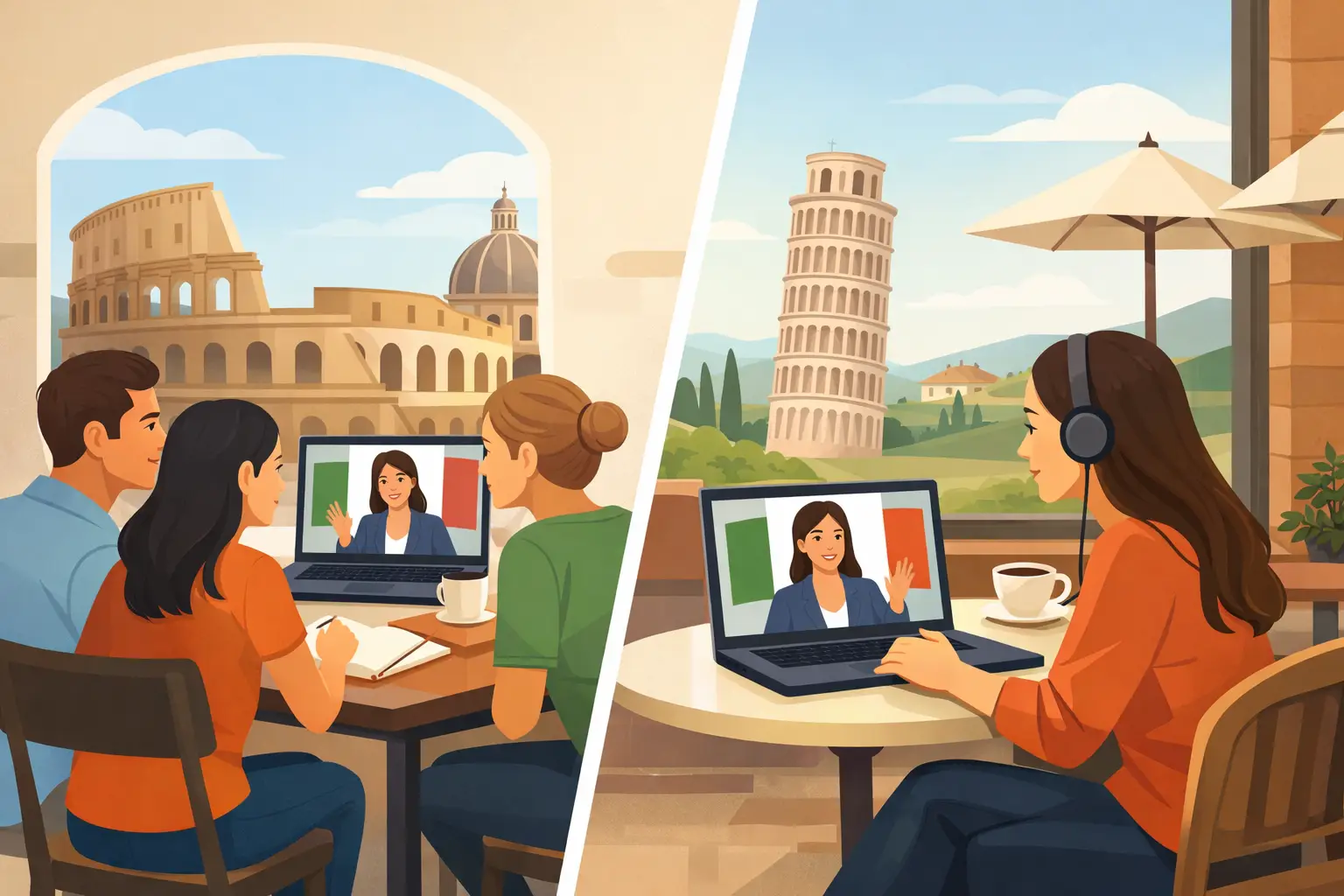
A learner told Daniele recently, “I want to speak more, but I’m worried I’ll hold everyone back.” Another said the opposite: “If I study alone, I know I’ll let work get in the way.” Both were choosing between group or private italian lessons, and both had a perfectly sensible concern.
The best format is not the one that sounds most serious or most flexible. It is the one you will attend consistently, enjoy enough to keep using, and that gives you the kind of practice your goal requires. A small online group can make Italian part of your week. A private lesson can focus every minute on exactly what you need. Neither is automatically better.
How Group or Private Italian Lessons Differ
The biggest difference is not simply class size. It is where the attention, energy, and responsibility sit.
In a private lesson, the teacher can adjust the pace immediately. If you are planning a move to Italy, preparing for a university program, or need to discuss your work with Italian colleagues, your lesson can revolve around those situations. You might spend one session practicing how to explain a problem to a landlord and the next refining the polite language needed for a professional email.
In a group class, you learn with other adults who are working through the same stage of Italian. You hear different voices, accents, mistakes, questions, and ways of expressing an idea. That variety is valuable because real conversations do not follow a script. You also gain a gentle form of accountability: people expect to see you next week.
At The Italian Lesson, small classes are designed so students still have meaningful speaking time rather than sitting silently through a lecture. The teacher guides the group, corrects what matters, and makes space for everyone to participate.
The real advantage of group lessons
Many adults assume a group means less personal learning. It can mean less one-to-one correction, certainly, but it also offers something private lessons cannot fully reproduce: interaction with peers.
Imagine you are practicing ordering at a bar. Your teacher asks, “Che cosa prende?” One classmate orders a coffee, another asks for sparkling water, and you decide you want a cornetto. You have to listen, respond, wait your turn, and adapt when someone says something unexpected. That is much closer to the rhythm of a real exchange in Italy.
Anna often sees quieter students become more confident after a few weeks of this kind of practice. At first, they may prepare every answer in English. Soon, they begin reacting naturally: “Anch’io!” “Davvero?” “Che bello!” Those small responses are where conversational confidence starts.
Group lessons can be especially helpful if you want a clear curriculum, regular motivation, and a social learning experience. They tend to be a good fit for beginners who like structure, travelers who want practical speaking practice, and learners returning to Italian after a long break.
The real advantage of private lessons
Private lessons are ideal when your needs are specific, your schedule is unpredictable, or you want concentrated attention on a particular obstacle.
Perhaps you understand Italian podcasts reasonably well but freeze when you have to answer. Perhaps your grandparents spoke Italian at home and you understand familiar phrases, yet you have never learned how to form sentences accurately. Or perhaps you are already advanced and want to sound more natural when telling stories, disagreeing politely, or using informal expressions.
A private teacher can notice patterns that might otherwise take longer to address. Maybe you consistently say sono caldo when you mean “I’m hot,” rather than ho caldo. Maybe your pronunciation is clear, but you place stress on the wrong syllable in words such as telefono. These details are easier to identify and revisit when the lesson is centered on you.
Private study also gives you freedom to bring real life into the room. You can practice a presentation, prepare questions for relatives in Italy, work through an Italian document, or rehearse an upcoming conversation. The work remains structured, but the content is highly personal.
Choose Based on Your Goal, Not Just Your Level
Your Italian level matters, but it should not decide everything. Complete beginners can thrive in either format. So can advanced speakers. The more useful question is: what kind of progress do you need next?
If your main goal is to build a dependable foundation, a group course gives you sequence. You move through essential grammar and vocabulary while using them in guided conversation. You also learn from questions you would not have thought to ask yourself.
If you need to reach a particular goal by a certain date, private instruction may be more efficient. A learner preparing for an Italian university interview does not need the same lesson as someone learning for a first trip to Rome. Individual sessions allow that distinction to shape the entire plan.
If your goal is fluency, consider what “fluency” means for you. It rarely means knowing every grammar rule. More often, it means being able to keep a conversation going when you cannot find the perfect word. Group lessons build that flexibility with multiple partners. Private lessons give you repeated, focused opportunities to close the gaps that interrupt you most.
Pace, Cost, and Time Between Lessons
There are practical trade-offs too. Group courses usually offer a more affordable way to learn live with a native Italian teacher. They follow set meeting times and a shared pace, which works well for learners who benefit from routine.
Private lessons cost more per hour because the teacher’s attention is entirely yours. In return, they can move faster through familiar material, slow down when a concept needs more work, and fit more easily around a demanding calendar.
Before choosing, be honest about your available study time. A private lesson is powerful, but it works best when you can review notes, complete exercises, and return ready to use what you covered. A group course has the same expectation. The difference is that the weekly rhythm of classmates can make preparation easier to protect.
For busy adults, the strongest choice is often the one with the fewest chances to postpone it.
You Do Not Have to Choose One Format Forever
Learning Italian changes as your life changes. A beginner may start in a group to gain a solid foundation and the encouragement of classmates. Later, they may take a few private lessons before a trip or to work on a stubborn pronunciation issue. Someone who begins privately because of a tight deadline may join a group afterward to keep speaking regularly.
This combination can be particularly useful for heritage learners. Group sessions provide broader conversation and new vocabulary, while occasional private work creates room for personal stories, regional family language, and areas of grammar that were never formally taught.
The format is a tool, not an identity. You are not “a group learner” or “a private learner” forever. You are someone learning to communicate in Italian.
Questions to Ask Before You Enroll
Instead of asking which option is best in general, ask yourself a few direct questions. Do I need to learn around a fixed schedule or a changing one? Am I motivated by other people, or do I prefer a lesson built around my own priorities? Do I need Italian for a specific situation soon? And can I give myself time between classes to review and practice aloud?
Your answers will point you in the right direction. If they point in two directions, that is normal. Start with the format that solves your most immediate problem, then adjust as your confidence grows.
FAQ About Group and Private Italian Classes
Are group Italian lessons good for beginners?
Yes. A well-organized beginner group gives you a clear path through basic Italian while letting you hear and use the language from the first classes. Small groups are especially useful because you can ask questions and practice speaking without being lost in a large class.
How many students should be in an online Italian group class?
Smaller is generally better for speaking practice. In a small group, each student has time to answer, ask follow-up questions, and take part in pair or group activities. The goal is not just to listen to Italian but to produce it regularly.
Are private Italian lessons worth it for travel?
They can be, particularly if your trip is soon or has a specific purpose. Private sessions can focus on checking into accommodations, ordering food, asking for directions, handling transport, and making friendly conversation. If you have more time before traveling, a group course can also provide excellent practical preparation.
Can I learn conversational Italian in a group class?
Yes, provided the course includes active speaking, listening, and interaction rather than grammar explanations alone. Conversation develops through repeated use: responding to questions, asking for clarification, reacting naturally, and learning how to continue when you make a mistake.
Should intermediate learners choose private or group Italian lessons?
It depends on the reason you feel stuck. Choose private lessons if you need targeted correction, specialized vocabulary, or help with a specific goal. Choose a group if you understand the basics but need more spontaneous conversation and the habit of speaking with different people.
The right lesson should leave you with more than completed exercises. It should give you one useful phrase, one clearer sound, or one small moment of courage to carry into your next real conversation in Italian.