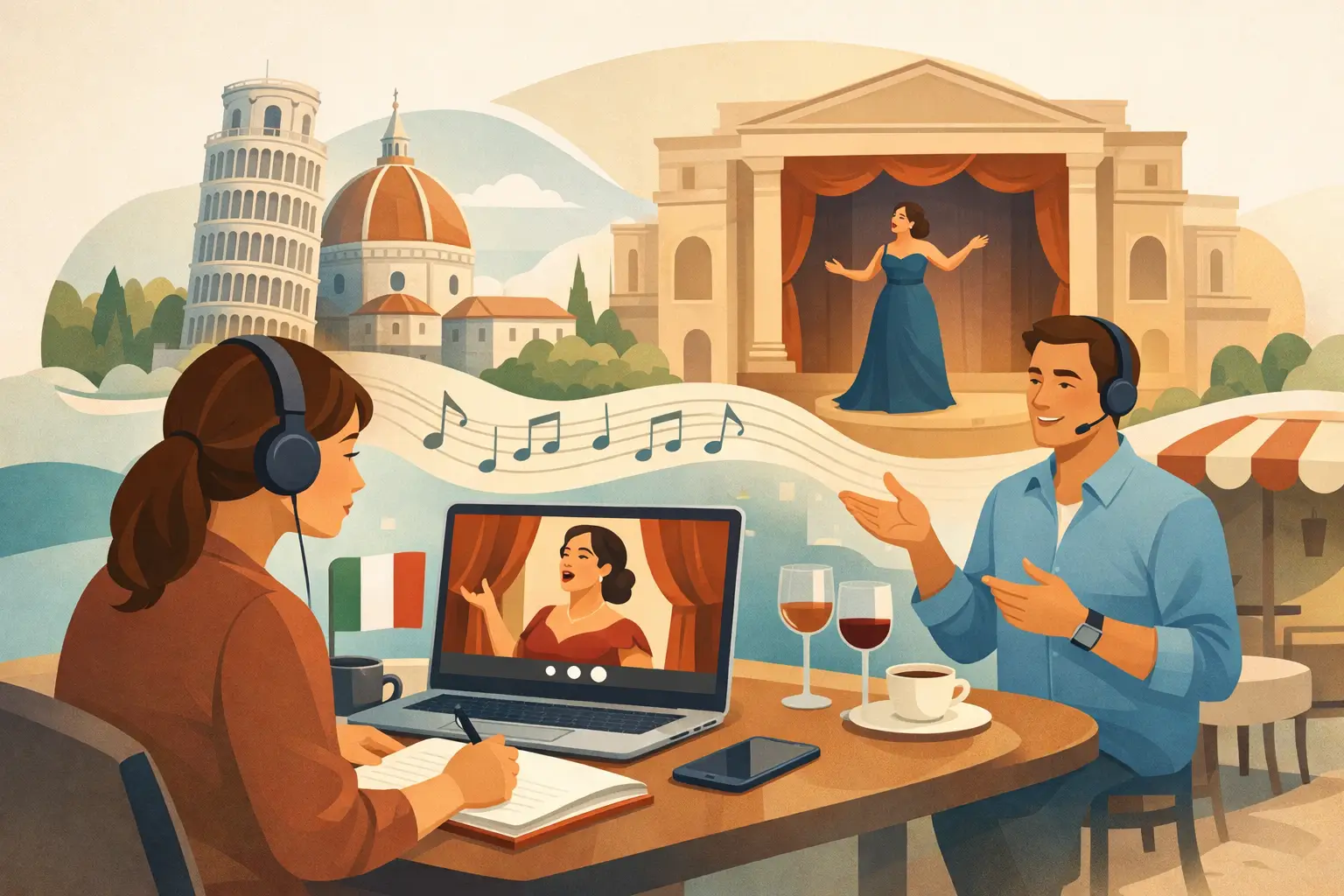
A student once told Daniele that she could recognize amore in nearly every opera she heard, but she still froze when she wanted to say, “I love this city” in Italian. That is the central challenge when you learn Italian through opera: the music can make the language memorable, but it does not automatically make it usable. With the right routine, though, opera becomes a remarkably rich way to train your ear, expand your vocabulary, and speak with more feeling.
Opera is not a replacement for conversation practice, structured grammar, or feedback from a teacher. It is a powerful companion to them. You hear Italian shaped by emotion, rhythm, regional color, and careful diction. Better still, you get a reason to return to the same words again and again.
Why learn Italian through opera works
Opera gives language learners something textbooks cannot always provide: repetition that feels meaningful. A short phrase may return several times in an aria, each time with a different musical color. That repetition helps words settle into your memory.
You also hear Italian vowels sustained clearly. In spoken Italian, native speakers connect words quickly: che cosa hai fatto? may sound almost like one long unit. Opera slows some sounds down and gives you time to notice the open, melodic quality of the language. This can be especially helpful for learners whose first language is English, where vowels often change or disappear in casual speech.
There is a cultural benefit, too. Works by Verdi, Puccini, Mozart, Rossini, and Donizetti open doors to Italian history, literature, social expectations, and ways of expressing affection, anger, honor, and regret. Even when the language is old-fashioned, the emotional situation is often immediately recognizable.
Still, opera Italian is stylized. Characters do not order coffee, reschedule a meeting, or ask where the train platform is. If your main goal is travel or conversation with family, use opera to enrich your everyday study rather than letting it become your entire study plan.
Start with the right opera for your level
Beginners do best with familiar music and short excerpts. You do not need to understand an entire three-hour opera before you begin. Choose one aria, duet, or chorus that you genuinely enjoy, then work with it for a week or two.
For early learners, look for pieces with clear, repeated phrases and accessible vocabulary. “La donna è mobile” from Rigoletto is catchy, but its message and grammar are not especially useful for daily conversation. “O mio babbino caro” from Gianni Schicchi has more practical emotional language, including mi piace and voglio andare.
Intermediate learners can benefit from scenes with dialogue. A duet gives you turns, reactions, questions, and changes in tone – all useful ingredients for real conversation. Advanced learners may enjoy comparing a libretto with a modern paraphrase, noticing how poetic word order differs from current spoken Italian.
Anna often encourages adult learners not to choose a piece simply because it is considered famous. The best first selection is one you want to hear again. Motivation matters because opera study asks for repeated, attentive listening.
A practical opera listening routine
Treat one excerpt as a small language lesson, not background music. Thirty focused minutes can be more useful than listening passively to an entire opera while answering emails.
First listen for the story, not every word
Listen once without stopping. Ask yourself: Who is speaking? What do they want? What feeling is driving the scene? You may know the plot already, but try to identify the emotional movement in the Italian itself.
Then read a short plot summary in English. This gives you enough context to make sense of what you will hear next without turning the session into a translation exercise.
Listen with the Italian text
On the second listen, follow the Italian libretto. Mark words you already recognize, including small but important words such as non, mai, sempre, qui, and perché. These appear constantly in real Italian.
Resist the urge to look up every unfamiliar word. Choose five to eight expressions that are frequent, expressive, or useful beyond the scene. For example, from an aria about longing, you might collect:
- non posso – I cannot
- senza di te – without you
- ascoltami – listen to me
- ti prego – please, I beg you
These phrases are more valuable than a long list of isolated nouns. They give you ready-made language you can adapt in conversation.
Notice grammar in context
Opera can make grammar memorable because the grammar carries emotion. If a character sings vorrei, you are hearing the conditional form of volere – “I would like” or “I wish.” If you find se avessi, you are entering the world of hypothetical language: “if I had.”
Do not try to analyze every line at once. Pick one pattern and make two ordinary sentences of your own. After hearing vorrei vederti, try: Vorrei visitare Roma or Vorrei parlare italiano meglio. The goal is to bring the structure out of the theater and into your life.
Speak with the singer, then speak as yourself
Play one short line, pause, and repeat it aloud. Copy the vowel sounds, the stress, and the linking between words. This is shadowing, and it is especially useful when you can listen to the same phrase several times.
Then remove the operatic intensity. Say the phrase in a natural speaking voice. A line like Che gelida manina may be too theatrical for a normal introduction, but its sound can still train your pronunciation. Follow it with something practical: Piacere, mi chiamo Sarah. Sono americana.
That final step matters. You are not trying to sound like a tenor at the grocery store. You are training your ear and mouth so everyday Italian feels more familiar.
What opera teaches well – and what it does not
Opera is excellent for listening closely, recognizing vowel sounds, learning expressive vocabulary, and developing a feel for sentence rhythm. It can also help heritage learners reconnect with Italian in an emotional, personal way.
It is less reliable for casual modern speech. Libretti may use literary vocabulary, inverted word order, or forms you will rarely use in a conversation. For instance, io t’amo is understandable, but ti amo is the more natural modern phrase. You may hear deh or or, words that belong more to poetry and period drama than to daily life.
A good rule is simple: enjoy the poetic line, then ask, “How would I say this to a friend today?” This question turns passive appreciation into active learning.
Build opera into a balanced Italian study plan
If opera is your main motivation, let it shape your study without narrowing it. Pair your listening with lessons that teach modern communication: introductions, questions, common verb forms, listening to normal-speed speech, and guided conversation.
In live classes, Daniele and Anna have seen learners make the strongest progress when they bring their interests into structured practice. An opera lover might learn the phrase Mi emoziona questa musica – “This music moves me” – then use it to explain why a particular scene matters. That is real conversation, not a recital.
You might reserve one weekly session for an opera excerpt and use the rest of your study time for practical Italian. Keep a notebook with three columns: the original line, its everyday equivalent, and one sentence about your own life. Over time, you will build a personal bridge between the language of the stage and the language you want to speak.
For learners who want support with that bridge, The Italian Lesson’s live classes and private lessons can provide the grammar explanations, correction, and speaking time that opera alone cannot offer.
FAQ: Learning Italian with opera
Can beginners learn Italian through opera?
Yes, if you begin with short, well-supported excerpts rather than full operas. Focus on sound, repeated phrases, and a few useful expressions. Beginners still need a foundation in everyday Italian, especially pronunciation, basic verbs, and sentence structure.
Is opera Italian different from modern Italian?
Often, yes. Opera uses poetic language and sometimes older grammar or word order. Much of it is still understandable, but you should check whether an expression is natural in current spoken Italian before using it yourself.
Which Italian operas are best for language learners?
Puccini and Verdi are good places to start because their music is memorable and recordings are easy to find. Choose by interest and clarity, not prestige. A short Puccini aria you enjoy is more useful than an acclaimed opera you never want to hear again.
Should I translate every line of an Italian libretto?
No. First understand the overall situation, then focus on selected phrases. Translating every word can make listening feel like homework and may pull your attention away from pronunciation, rhythm, and repeated language patterns.
Can singing help my Italian pronunciation?
It can help you hear and produce Italian vowels more clearly, especially when you repeat short lines carefully. But singing changes timing and emphasis, so follow it with normal spoken repetition. Your aim is clear, comfortable speech, not an operatic accent.
The next time an aria catches your attention, do not let the Italian wash over you as beautiful sound alone. Choose one line, understand it, repeat it, and make it yours. A language grows through these small returns – one phrase heard deeply, then spoken with confidence.