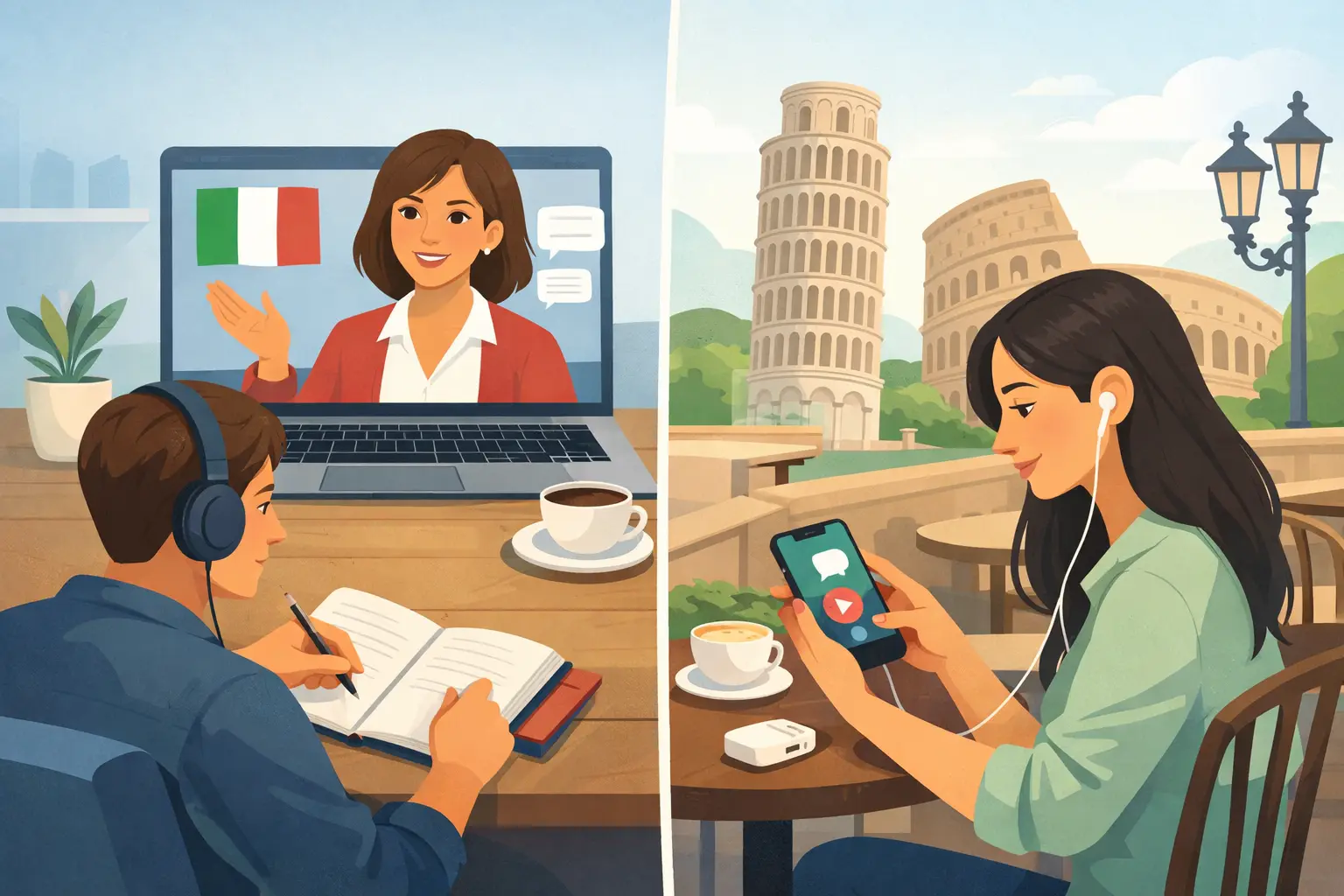
A learner recently told us, “I can recognize lots of Italian words on my app, but I freeze when someone asks me a question.” That gap is at the heart of the Italian tutor or app decision. Both can be useful, but they develop different parts of the language. The best choice is not the one with the most features. It is the one that helps you do what you actually want to do in Italian.
If your goal is to order at a bar in Rome, talk with relatives, contribute in a work meeting, or follow a conversation without rehearsing every sentence in your head, speaking practice needs a central place in your plan.
Italian Tutor or App: What Is the Real Difference?
An app is usually built for repetition and convenience. You can review vocabulary while waiting for an appointment, complete a short grammar exercise on the train, or listen to a dialogue before bed. That consistency matters, especially for busy adults. Apps can make daily contact with Italian feel manageable rather than intimidating.
A tutor or live teacher brings something an app cannot fully reproduce: responsive conversation. A teacher hears what you mean as well as what you say. They can notice that you are using essere where Italian requires avere, that your word order sounds translated from English, or that you understand a question but need a few extra seconds to answer naturally.
Neither option is automatically better. An app may be enough for a traveler who wants a small foundation before a short trip. A teacher is usually more valuable when your aim is conversation, a specific professional or academic goal, or confidence at an intermediate plateau. For many learners, the most effective answer is not tutor versus app. It is knowing which role each should play.
What an App Can Do Very Well
Apps are especially helpful for building a routine. Short, repeated sessions can strengthen recognition of high-frequency words and structures such as voglio, posso, devo, and mi piace. They can also help beginners get comfortable with the sounds and basic spelling of Italian before their first class.
They work well for reviewing material you have already encountered with a teacher. If you learned food vocabulary in class, five or ten minutes of focused app practice can help it stay available when you need it. The app is acting as review, not as your only source of Italian.
The limitation is that tapping the correct answer is not the same as producing language under real conditions. In a conversation, no one gives you four options. You need to choose a verb, remember an article, understand the reply, and continue the exchange – often while the other person speaks faster than expected.
Consider this simple situation:
> Barista: Cosa prende? > > You: Vorrei un cappuccino e un cornetto, per favore. > > Barista: Da mangiare qui o da portare via?
An app may teach each line. Live practice teaches you not to panic when the final question is unfamiliar, or when the barista says al banco instead of using the exact words you practiced.
What an Italian Tutor Adds
A good Italian tutor does more than explain grammar. They create the conditions for useful, repeated speaking. They adjust questions to your level, give you language you can reuse, and help you recover when you lose your train of thought.
Daniele often sees adult learners who know the rule but hesitate to use it. For example, a student may understand the difference between sapere and conoscere in an exercise, yet say conosco nuotare in conversation. A teacher can correct this kindly in the moment: So nuotare, then ask a related question so the student immediately uses the right phrase again.
That immediate loop matters. You make a mistake, understand why it happened, try again, and continue communicating. Over time, corrections stop feeling like interruptions and become part of how you build accuracy.
Anna also finds that learners become more willing to speak when the class makes room for imperfect Italian. Adults often arrive with a fear of “getting it wrong,” particularly if they studied another language years ago. In a supportive lesson, you learn useful repair phrases such as Come si dice…? (How do you say…?), Puoi ripetere? (Can you repeat?), and Non sono sicuro/a, ma penso che… (I’m not sure, but I think that…). Those phrases keep a real conversation moving.
Feedback Is More Than Correction
Useful feedback is specific. “Your Italian is good” is pleasant, but it does not tell you what to practice. A teacher can say, “Your vocabulary is strong. This week, focus on using the past tense when telling stories, and slow down slightly at the end of longer sentences.” That gives you a clear next step.
A qualified native teacher can also explain register and context. You may learn that Vorrei is a polite, reliable choice in a store, while Mi dai…? can sound more casual and depends on tone and situation. These are details that help you sound natural without trying to imitate every regional expression you hear online.
Choose Based on Your Goal, Not Your Guilt
Many learners feel they should be able to learn alone because an app is available. But independent practice and guided instruction are different tools. Choosing a teacher is not a failure of discipline. Choosing an app is not a shortcut if it supports a consistent routine.
An app may be a sensible primary tool if you are starting from zero, have a limited budget, and need a low-pressure way to test your interest. Add listening and simple speaking aloud from the beginning, even if it is only reading short dialogues.
A tutor or structured live course is likely the stronger primary choice if you want to speak with family, prepare for an Italian university program, use Italian at work, or move beyond the beginner stage. These goals require feedback, active listening, and practice responding in your own words.
If you are returning to Italian after a long break, a teacher can also save time. Rather than restarting every lesson in an app, you can identify what you still know and target the areas that are actually holding you back.
A Balanced Plan for Busy Adults
The most sustainable approach is often a blend: live instruction for direction and conversation, self-study for repetition between lessons. You do not need hours every day. You need regular contact with Italian and a reason to use it.
A realistic week might include one live class or private lesson, several short review sessions, and one longer session for listening or writing. After class, write down five expressions that came up naturally. Then use each one in a sentence about your own life. This turns class language into personal language.
For instance, if you practiced mi sono accorto/a che… (I realized that…), do not leave it in a notebook. Say: Mi sono accorta che capisco di più quando ascolto lentamente. The sentence becomes more memorable because it says something real.
At The Italian Lesson, this is why live teaching is paired with resources such as transcripts, subtitles, exercises, and downloadable materials. The goal is not to keep you busy with Italian. It is to help you return to useful language often enough that it becomes easier to retrieve in conversation.
How to Tell Whether Your Current Method Is Working
Forget streaks and lesson counts for a moment. Ask yourself whether you can do a little more than you could last month. Can you answer an unexpected follow-up question? Can you describe your weekend using more than isolated words? Can you notice a phrase in a podcast and try it yourself?
Progress can be quiet. One learner may first need ten seconds to form a response, then six. Another may stop translating every sentence before speaking. These changes are meaningful because they make Italian more available when a real person is waiting for your answer.
If you use an app and feel motivated, keep it. But if you have been collecting vocabulary for months without speaking, add guided conversation. If lessons feel demanding but you forget material between them, use an app or flashcards for targeted review. Adjust the plan rather than abandoning it.
FAQ
Is an Italian tutor better than an app for beginners?
Not always. An app can help a complete beginner build familiarity with common words and sounds. However, early lessons with a tutor can prevent habits that later become difficult to change, especially pronunciation and English-style sentence patterns. Even occasional live practice gives beginners a valuable chance to ask questions and speak from the start.
Can I become conversational in Italian using only an app?
You can build useful vocabulary and understand basic patterns with an app, but conversation requires interaction. To become more conversational, practice listening to varied voices, answering open questions, and handling replies you did not expect. A tutor, small group, language exchange, or conversation partner can provide that missing interaction.
How often should I take Italian lessons with a tutor?
For most adult learners, one lesson or group class per week works well when paired with short practice sessions between classes. If you have an urgent goal, such as an exam or relocation, two lessons may help. Consistency is more helpful than scheduling an intense week and then stopping for a month.
Are group Italian classes as helpful as private lessons?
They can be, depending on your goal. Private lessons offer personalized pacing and focused support. Small groups add the useful challenge of listening to other learners, responding to different people, and seeing several ways to express an idea. The key is having enough opportunities to speak and receive clear feedback.
What should I practice between Italian lessons?
Review vocabulary and expressions from your most recent lesson, listen again to material with a transcript if available, and speak aloud for a few minutes. Try answering a class question differently each day. Small, active practice is usually more effective than passively reading a long grammar explanation.
The right choice should make Italian feel more present in your life, not more like another obligation. Start with the tool that you will genuinely use, then make sure it leads you back to the thing you came for: a real exchange, in your own Italian, with another person.