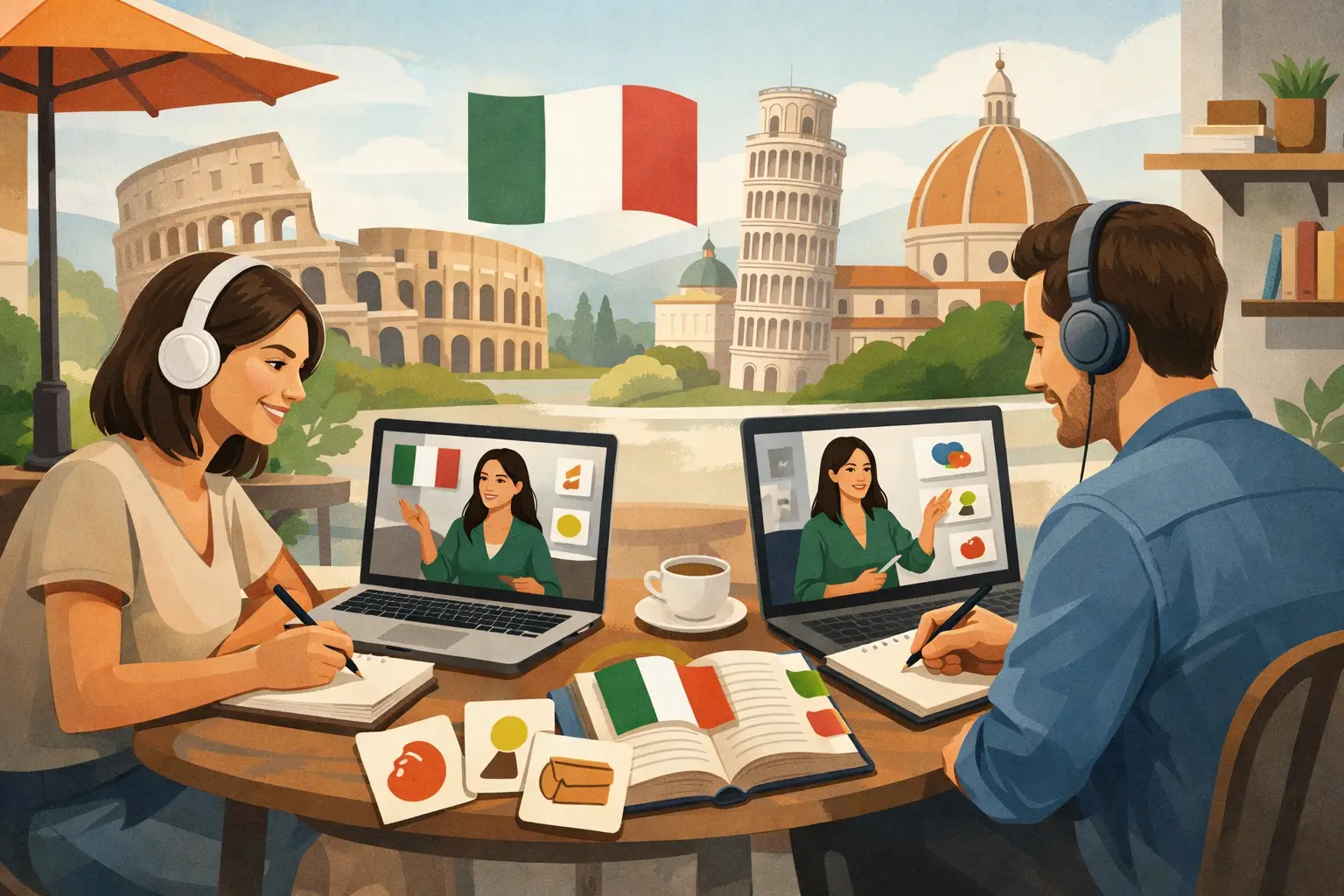
A student can know the Italian word for “butterfly” and still freeze when a barista asks, Vuoi altro? Do you want anything else? That is the difference between collecting words and learning language you can use. If you are wondering how to build Italian vocabulary, start by choosing words that belong to the life you want to live in Italian: ordering lunch, speaking with relatives, joining a class discussion, or making plans with friends.
Daniele and Anna see this often in lessons with adult learners from many countries. Students who study fewer words in meaningful groups usually begin speaking sooner than students who memorize long, random word lists. Vocabulary grows best when every new word has a situation, a sound, and a reason to return.
How to Build Italian Vocabulary for Conversation
The most useful Italian vocabulary is not always the most impressive. At an early stage, magari may help you more than a rare literary adjective. You will hear it in several everyday ways: “maybe,” “if only,” or “I wish.” Its precise meaning depends on context, which is exactly why it is worth learning through examples rather than a translation alone.
Instead of writing down isolated words, collect short pieces of language called chunks. A chunk gives you grammar, rhythm, and a ready-made response at the same time. Compare these two approaches:
- prenotare = to reserve
- Vorrei prenotare un tavolo per due. = I’d like to reserve a table for two.
The second version is far more likely to come back when you need it. You can later change one piece: un tavolo per quattro, per domani sera, or a nome Smith. This is how vocabulary becomes flexible.
Choose themes that match your real goals, but do not stay with one topic for weeks. A traveler might rotate among cafés, transportation, directions, hotels, and polite requests. A heritage learner might work on family stories, childhood, opinions, and the expressions relatives use at the table. A professional may need meetings, deadlines, introductions, and tactful disagreement.
Build word families, not lonely words
Italian makes patterns visible. When you learn decidere (to decide), add decisione (decision), deciso (decided), and indeciso (undecided). When you meet felice (happy), notice felicità (happiness). These connections reduce the amount you need to memorize from scratch.
Pay attention to endings, but do not turn every study session into a grammar lecture. The goal is recognition first, then use. If you notice that many nouns ending in -zione resemble English words, such as informazione, situazione, and prenotazione, you have found a useful pattern. Still, check gender and usage as you go. Similar-looking words can be helpful, but they are not always identical in meaning.
Learn common pairs together: aprire/chiudere (open/close), entrare/uscire (go in/go out), prima/dopo (before/after), and sempre/mai (always/never). These words naturally create sentences and help you respond faster.
Make New Italian Words Memorable
Memory needs repeated contact, not one heroic study session on Sunday. A reliable routine can be short. Fifteen to twenty focused minutes on most days is usually more useful than cramming 100 words once a month.
Try this four-part cycle:
- Meet new vocabulary in a dialogue, short video, lesson, or simple article.
- Notice one useful phrase and say it aloud several times.
- Recall it later without looking, ideally the same day and again a few days later.
- Use it in a sentence that is true for you.
Suppose you learn fare una passeggiata (to go for a walk). Do not stop at the translation. Say: Dopo cena faccio spesso una passeggiata. Then make it personal: Nel fine settimana faccio una passeggiata con il mio cane. A personal sentence has a stronger memory hook because it connects to an image and experience you already know.
A notebook can work very well, especially if you organize it by situations rather than alphabetically. Keep a page for “At the pharmacy,” another for “Small talk,” and another for “Useful reactions.” Under “Useful reactions,” you might add Che bello! (How nice!), Che peccato! (What a shame!), Non ne ho idea (I have no idea), and Dipende (It depends). These are high-value phrases because they help you keep a conversation moving even when your vocabulary is still limited.
Digital flashcards are also useful, particularly for spaced review. But a flashcard should prompt a complete thought whenever possible. Rather than putting stanco on one side and “tired” on the other, use: “After a long day of work, I am tired” and produce Dopo una lunga giornata di lavoro, sono stanco/stanca. You are practicing the word, the agreement, and a natural sentence together.
Say the words before you feel ready
Many English-speaking learners build a large passive vocabulary. They recognize scegliere, capire, and succedere when reading, but cannot retrieve them quickly in conversation. The cure is not more reading alone. It is small, frequent moments of retrieval aloud.
After listening to a short Italian conversation, pause and repeat one line with the speaker’s rhythm. Then answer it differently. If someone says, Che cosa fai stasera? you can practice several responses: Resto a casa, Esco con amici, or Non lo so ancora. This is more valuable than repeating a single sentence perfectly because you are making choices.
A simple five-minute voice note is another excellent tool. Describe what you did that day, what you are doing tomorrow, or what you need to buy. You will quickly find the gaps in your vocabulary. Write down only the words that stopped you, learn them as phrases, and use them again in your next recording.
Learn From Italian You Can Hear in Real Life
Textbooks provide useful structure, but authentic Italian teaches you what people actually say. Listen for recurring phrases in interviews, podcasts, television clips, songs, and conversations with native speakers. You may notice that Italians often say mi sa che for “I think” or “it seems to me,” as in Mi sa che piove (I think it’s raining). This is the kind of phrase that adds naturalness quickly.
Use transcripts and subtitles carefully. First, listen once for the general idea. Next, read and underline only three to five expressions worth keeping. Finally, listen again and repeat them. Trying to save every unfamiliar word turns a useful activity into a frustrating one.
Context also helps you learn which words belong together. You may know fare means “to do” or “to make,” but real examples teach you fare colazione (have breakfast), fare una domanda (ask a question), and fare attenzione (pay attention). Collocations like these are the building blocks of fluent-sounding Italian.
Let Conversation Show You What to Study Next
A good lesson gives vocabulary a job. In a small group or private class, a teacher can hear whether you understand a word but avoid using it, whether your pronunciation makes it hard to recognize, or whether you are choosing a correct but overly formal expression.
For example, a learner may know piacere but repeatedly say Mi piace andare in Italia when they mean “I would like to go to Italy.” A teacher can help them distinguish mi piace from mi piacerebbe. That correction is memorable because it solves a real communicative need.
Bring a short vocabulary list to class, but make it selective. Three phrases you genuinely want to use are enough. Ask your teacher how natural they sound, what alternatives Italians use, and when each option fits. At The Italian Lesson, this kind of practical feedback is central to helping adults move from studying Italian to speaking it.
FAQ
How many Italian words should I learn each day?
Aim for five to ten useful words or phrases, then review older material. The right number depends on your schedule and level, but retention matters more than a large daily target. Three phrases you can use are better than 20 words you forget by Friday.
What is the fastest way to remember Italian vocabulary?
Attach each word to a specific sentence, image, or experience, then retrieve it several times over the next few days. Saying it aloud and using it in conversation makes recall much stronger than rereading a list.
Should I learn Italian nouns with articles?
Yes. Learn la macchina, not only macchina, and il problema, not only problema. The article helps you remember gender and gives you a more natural starting point for building sentences.
How can I improve my Italian vocabulary for travel?
Prioritize phrases for requests, directions, time, numbers, transport, restaurants, and problem-solving. Practice complete exchanges, such as asking for a train platform or explaining a food preference, rather than studying travel words in isolation.
Why do I understand Italian words but cannot speak them?
Recognition is easier than retrieval. Add short speaking practice: repeat a phrase, change one detail, and use it in your own response. Your active vocabulary grows when you regularly produce language without reading from notes.
The best vocabulary plan is one you can return to with curiosity. Notice a phrase, make it yours, and give yourself another reason to say it tomorrow. Those small encounters are how Italian gradually begins to feel like your own voice.