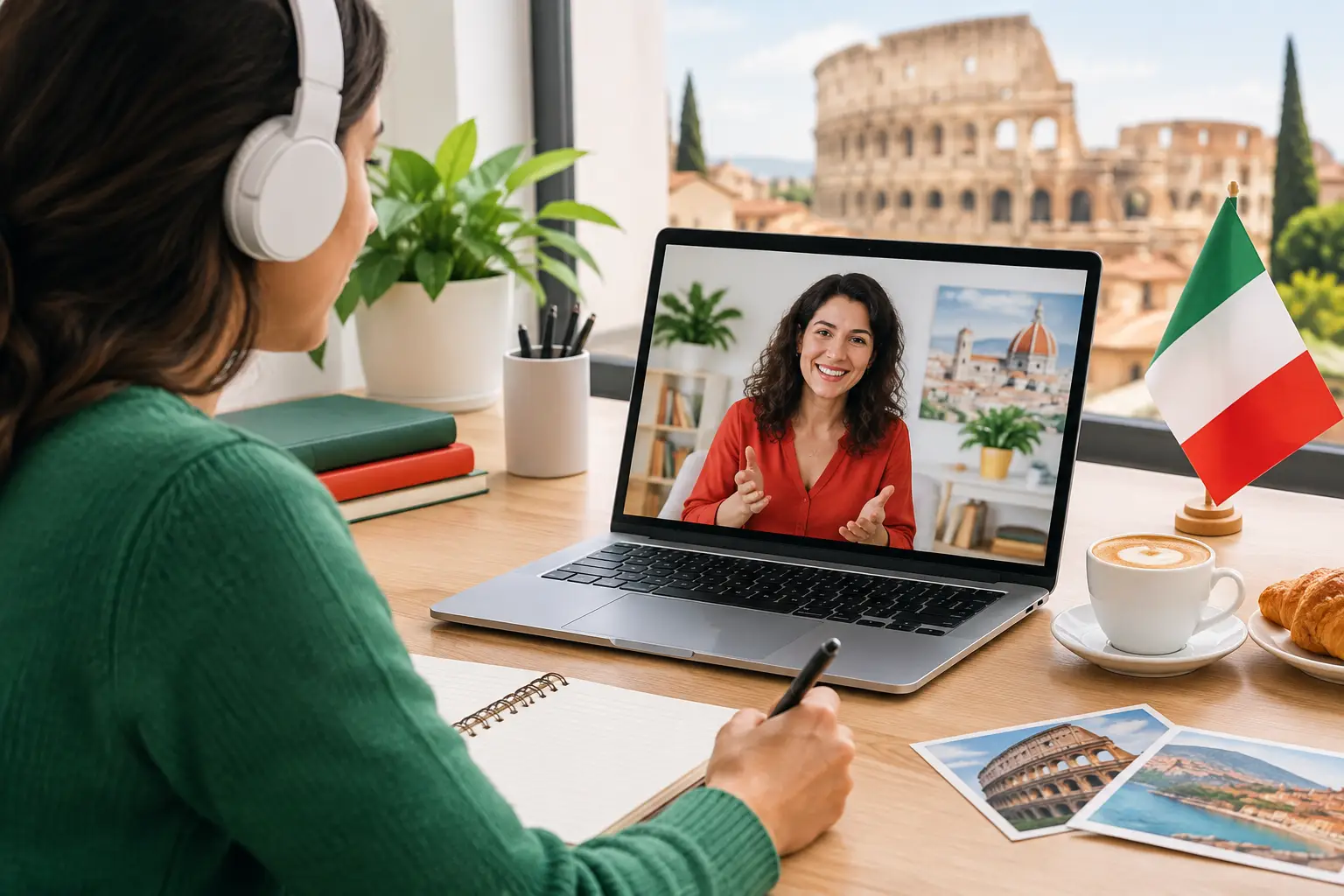
A good Italian video course should do more than explain verbs while you watch from the couch. It should help you recognize Italian as people actually speak it, give you a clear next step when you feel stuck, and make it easier to use the language out loud.
That matters because adult learners rarely struggle from a lack of motivation. More often, they have watched many lessons, saved vocabulary lists, and still freeze at a simple question such as, Che cosa fai nel weekend? – “What do you do on the weekend?” The right course turns passive exposure into regular, useful practice.
What an Italian video course can do well
Video learning is particularly helpful for Italian because so much meaning lives beyond individual words. You can hear the rhythm of a sentence, notice where a speaker stresses a word, see a gesture, and replay a short exchange until it begins to feel familiar.
For example, a textbook may teach Va bene as “all right” or “okay.” In a video, you can hear how its meaning changes with tone. A quick, cheerful va bene! can mean “great, let’s do it.” A slower va bene… may mean “fine, I suppose.” Those small details are part of real communication.
An Italian video course also gives busy learners control over pace. You can pause before a new structure, repeat a dialogue during lunch, or revisit a difficult lesson before bed. That flexibility is valuable, but it comes with a trade-off: a course cannot notice your hesitation or correct your pronunciation unless it includes guided speaking practice or you add that practice yourself.
Daniele often sees learners who understand far more Italian than they believe they can speak. Video lessons can help close that gap when students stop treating them as something to watch and start treating them as material to answer back to.
How to choose an Italian video course
The best choice depends on your starting point and your reason for learning. A total beginner needs a course that explains sound, basic sentence patterns, and survival conversations without assuming prior knowledge. An intermediate learner may need less explanation and more natural listening, useful connectors, and chances to move beyond short answers.
Before enrolling, look closely at four things: the teaching sequence, the quality of the Italian you hear, the practice built into each lesson, and the support materials available afterward.
Look for a clear progression
A collection of attractive standalone videos is not necessarily a course. Early lessons should prepare you for later ones. You should be able to see how greetings lead to introducing yourself, how present-tense verbs lead to daily routines, and how those routines eventually help you tell a story about yesterday or make plans for next week.
Clear progression is especially reassuring for beginners. Italian grammar has patterns, but it also has exceptions that make more sense when introduced at the right moment. Learning sono and ho before trying to memorize every past-tense form is not limiting your Italian. It is building a foundation you can use.
Listen for natural, understandable Italian
Native-speaker teachers matter, but speed alone does not make a lesson authentic. Good teaching uses natural Italian while making it understandable through context, repetition, transcripts, subtitles, and carefully chosen examples.
Listen for language you might genuinely need:
- Vorrei prenotare un tavolo per due. – “I’d like to book a table for two.”
- Mi può aiutare? – “Can you help me?”
- Non ho capito, può ripetere? – “I didn’t understand, can you repeat that?”
These sentences are more useful when you hear them inside a short situation, not as isolated lines to memorize. A conversation at a bar, a phone call, or a chat with a neighbor teaches vocabulary and social tone at the same time.
Check what happens after the video ends
Watching is only the first stage. A course becomes much more effective when it includes transcripts, subtitles, downloadable notes, exercises, and short tests that show whether you understood the lesson.
Anna’s advice to adult learners is simple: do not measure a lesson by how enjoyable it was to watch. Measure it by whether you can use two or three new phrases without looking at the screen. That is a realistic, encouraging standard – and it keeps progress visible.
A strong lesson might ask you to choose the right form, complete a short reply, then say your own answer aloud. For instance, after learning andare and days of the week, you might practice this exchange:
A: Vai al mercato sabato? B: Sì, ci vado con mia sorella. E tu?
Then change the details to fit your real life: No, sabato lavoro, ma domenica vado al parco. You are no longer repeating Italian. You are communicating something true.
A study routine that makes video lessons stick
You do not need a two-hour study block to benefit from a course. Consistency matters more than occasional marathons. For many adults, three or four short sessions per week are more sustainable than one long session that gets postponed.
First, watch a new lesson once for the main idea. Do not pause every few seconds. Your goal is to understand the situation and notice what you already know.
Next, watch it again with subtitles or a transcript. Pause to repeat key phrases aloud. Copy the speaker’s rhythm rather than reading each word with English pronunciation. Italian vowels are clear and steady, and practicing the sound of a complete phrase is usually more helpful than practicing a single word ten times.
Finally, use the language away from the video. Say a few sentences while making coffee, send yourself a short voice note, or write a tiny message such as: Oggi sono molto occupato, ma stasera studio italiano. “Today I’m very busy, but tonight I’m studying Italian.” This small step tells your brain that Italian is something you use, not simply recognize.
If you can, combine self-paced study with live conversation. Video courses are excellent for preparation and review; a teacher or conversation partner helps you respond when the script changes. At The Italian Lesson, that blend is central: structured video learning gives you material to revisit, while live instruction gives you a place to test it with real people.
Signs you may need more than video alone
A video course may be enough for a short-term goal, such as preparing for a trip or refreshing Italian you studied years ago. It may also be your preferred way to begin if your schedule changes week to week.
But consider adding live lessons if you regularly understand the videos yet cannot form an answer quickly, if pronunciation worries you, or if you need Italian for university, work, or an upcoming conversation with family. These are not failures of self-study. They are normal moments when feedback becomes especially useful.
The goal is not to finish every video perfectly. The goal is to become more comfortable responding, asking follow-up questions, and recovering when you do not understand. Even fluent speakers say Come scusa? or Puoi dirlo di nuovo? Sometimes confident Italian begins with knowing how to keep a conversation going.
Frequently asked questions
Is an Italian video course good for complete beginners?
Yes, provided it starts from the beginning and explains pronunciation, basic sentence structure, and everyday vocabulary clearly. Beginners should avoid courses that jump straight into fast conversations without enough support.
Can I learn to speak Italian from videos?
Videos can build listening skills, vocabulary, and useful speaking habits, especially when you pause and respond aloud. To become comfortable in unscripted conversation, add regular speaking practice with a teacher, classmate, or language partner when possible.
How long should I study Italian with video lessons each week?
Aim for three to five short sessions of 20 to 30 minutes if that fits your schedule. A manageable routine you repeat is more effective than an ambitious schedule you cannot maintain.
Should I use subtitles in an Italian video course?
Yes, but use them strategically. Watch once without subtitles to train your ear, then watch with Italian subtitles or a transcript to confirm what you heard. English subtitles can help at the beginning, but try not to rely on them forever.
What level of Italian can I reach with a self-paced course?
That depends on the course structure, your consistency, and how much you speak outside the lessons. A self-paced course can build a strong foundation, but progress becomes more complete when listening, reading, writing, and conversation all have a place.
Choose a course that makes you want to return tomorrow, not one that asks you to be perfect today. A few useful Italian sentences, practiced often and used with curiosity, can take you much farther than a long list of rules you never say aloud.