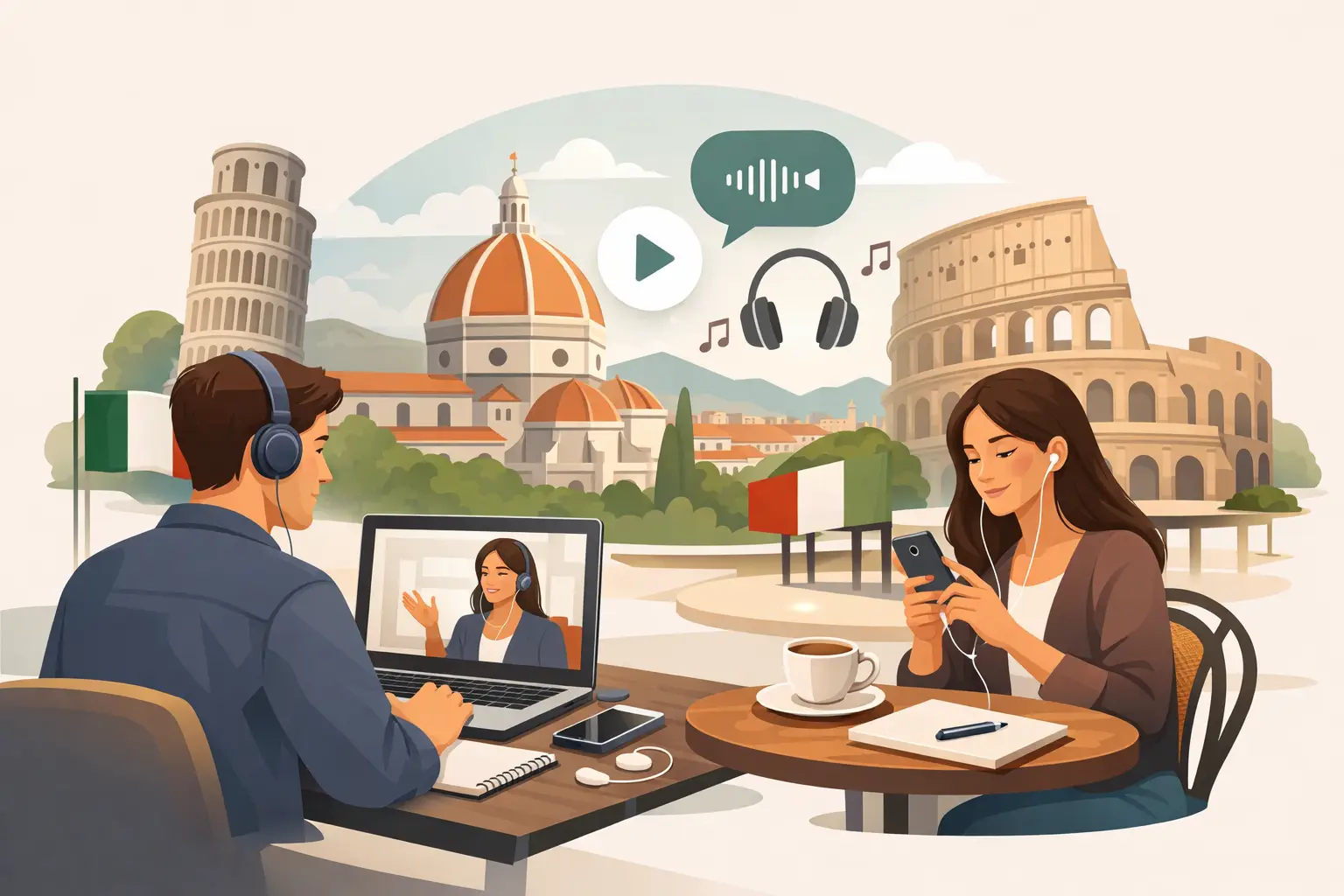
A learner can know plenty of Italian vocabulary and still freeze when a barista says, “Vuoi anche lo scontrino?” The problem is rarely intelligence or effort. Real Italian arrives connected, fast, and full of small words that textbooks often give too little attention: allora, cioè, magari, dai.
The best tools for Italian listening help you meet that reality gradually. They should give you understandable input, then move you toward spontaneous speech from different regions, ages, and situations. As Daniele often sees in class, adult learners improve most when they stop treating listening as a test and start treating it as a daily habit of noticing.
What makes a listening tool worth your time?
A useful resource is not necessarily the one with the fastest speakers or the most episodes. For beginners, the best material has a clear topic, repeated phrases, and support such as a transcript, subtitles, or a glossary. Intermediate learners need more natural speed and a wider range of voices. Advanced learners benefit from material made for Italians, including interruptions, humor, and imperfectly organized conversation.
The goal is not to understand every word. It is to catch the situation, the key information, and the speaker’s intention. If someone says, “Guarda, magari ci sentiamo domani,” you may not need to translate each word to understand that they are suggesting, rather than firmly arranging, a call tomorrow.
10 best tools for Italian listening
1. Graded audio with transcripts
Graded listening tracks are a sensible starting point for beginners and lower-intermediate learners. Choose short recordings built around everyday situations: ordering lunch, introducing yourself, asking for directions, or making an appointment. Listen once without reading, then check the transcript and listen again.
This approach teaches your ear to connect the written Italian you know with the sounds you hear. It is especially helpful with word boundaries. “Che cosa hai fatto?” can sound very different when spoken naturally from how it looks on a page.
2. Slow Italian news
Slow news is useful because the vocabulary is current but the delivery is more measured than a regular broadcast. It works well for learners around A2 to B1 who want to move beyond scripted dialogues without jumping straight into rapid television debates.
Do not try to follow every story. Pick one short item, identify the subject, and write down three words or phrases you hear more than once. Over time, news listening also gives you useful language for dates, numbers, public life, and opinions.
3. Italian public radio and news clips
Once you can follow slow material, use short clips from Italian radio or public news programs. These expose you to real pacing and a professional, generally clear register. Start with weather reports, cultural segments, or short local reports before attempting long political discussions.
A good challenge is to listen for concrete details: the city, the event, the time, and one quoted opinion. This keeps the exercise active and prevents the discouragement that comes from trying to decode an entire report at once.
4. Podcasts made for native speakers
Native-speaker podcasts are one of the best tools for Italian listening at B1 and above because they contain the rhythm of actual conversation. Hosts reformulate ideas, hesitate, laugh, and use expressions such as “nel senso” and “alla fine.” That is exactly the language learners need to recognize in real life.
Choose a subject you genuinely care about, whether that is history, design, sports, books, or current affairs. Interest matters. You will return to a podcast about a subject you love far more often than one you chose only because it seems educational.
5. Television with Italian subtitles
Italian subtitles can be a bridge between carefully graded material and unscripted speech. Watch a short scene first with Italian subtitles, not English ones. Then replay it without subtitles and see what remains clear.
Be selective. A historical drama full of period language may be entertaining but difficult. A contemporary series, interview, or cooking competition usually provides more useful everyday Italian. Notice how characters soften requests, disagree politely, or react with surprise.
6. Short video interviews
Street interviews, artist interviews, and behind-the-scenes clips are excellent for hearing a variety of accents and speaking styles. Because each video is short, you can repeat it without turning practice into a major project.
Anna often encourages learners to focus on one speaker at a time. A two-minute interview may be enough to notice how that person begins answers, buys time, or emphasizes a point. These small patterns make your own Italian sound more natural later.
7. Audiobooks you already know
A familiar novel in Italian reduces the mental load of listening. You already understand the plot, so your attention can go to pronunciation, intonation, and recurring vocabulary. This is often more enjoyable than forcing yourself through a difficult new book.
For B1 learners, children’s or young adult fiction can be a smart choice, not a childish one. The narration is often clear, and the language still has enough variety to stretch your comprehension.
8. Music with printed lyrics
Songs are memorable, emotional, and useful for rhythm, but they are not a complete listening course. Singers may stretch vowels, swallow consonants, or use poetic grammar. Treat music as an enjoyable supplement rather than proof that you can understand everyday speech.
Choose one song and read the lyrics after your first listen. Look for contractions and colloquial phrases. Then sing along quietly. Repeating a line such as “Non ci penso più” can help your ear recognize linked sounds in faster conversation.
9. Voice messages from real conversations
Voice messages are among the most realistic tools because they resemble how many Italians communicate with friends, family, and colleagues. They are often informal, quick, and full of context. If you have an Italian-speaking exchange partner or friend, ask to trade short messages about a specific topic.
Keep them manageable. A 30-second message about weekend plans is better than a five-minute monologue. Reply with what you understood and one follow-up question. That turns passive listening into communication.
10. Teacher-led listening and feedback
Independent practice is powerful, but it cannot always tell you why you missed something. Was the speaker using a regional pronunciation? Did two words join together? Were you expecting a formal phrase when the speaker used an informal one?
In a live class or private lesson, a native teacher can replay a short clip, explain the useful language, and help you practice responding. At The Italian Lesson, this kind of guided work helps learners connect listening practice to the conversations they actually want to have.
A simple routine that works
For most busy adults, 15 to 20 focused minutes is more valuable than a long session once a week. Use the same short audio three times. First, listen for the general meaning. Second, listen with support and note useful phrases. Third, listen again without support and say a brief response aloud.
For example, after hearing someone say, “Scusa, ma oggi non riesco proprio,” you might answer, “Va bene, nessun problema. Facciamo domani?” You are training your ear and your speaking reflex together.
Avoid changing resources every day. Spend a week with one podcast, series, or audio course so that the voices and format become familiar. Then add variety gradually. Familiarity builds confidence; variety builds flexibility.
FAQ about Italian listening practice
How can I improve Italian listening as a beginner?
Begin with short audio that includes a transcript or Italian subtitles. Listen to the same clip more than once, aiming first for the main idea rather than every word. Five to ten minutes daily is enough to establish a useful habit.
Should I use Italian or English subtitles?
Use Italian subtitles whenever possible. They support sound-to-spelling recognition without pulling you back into translation. English subtitles can help with a difficult scene, but rely on them sparingly.
Why does spoken Italian sound faster than written Italian?
Italian speakers connect words, shorten common phrases, and use fillers. Your ear needs repeated exposure to recognize those patterns. The speed is real, but much of the difficulty comes from unfamiliar sound connections, not from individual words being too advanced.
Is it helpful to listen to Italian while doing other things?
Background listening can help you get used to the sound of Italian, especially with music or radio. For measurable progress, however, set aside focused listening time when you can replay, notice, and respond to what you hear.
How long does it take to understand Italian conversations?
It depends on your starting level, consistency, and the type of conversation. A clear discussion about a familiar topic becomes understandable much sooner than a fast group conversation with slang. Track progress by what you can do: follow plans, catch key details, and answer naturally.
The aim is not to build a perfect ear before you speak. Let listening and speaking grow together, one short, real Italian exchange at a time.