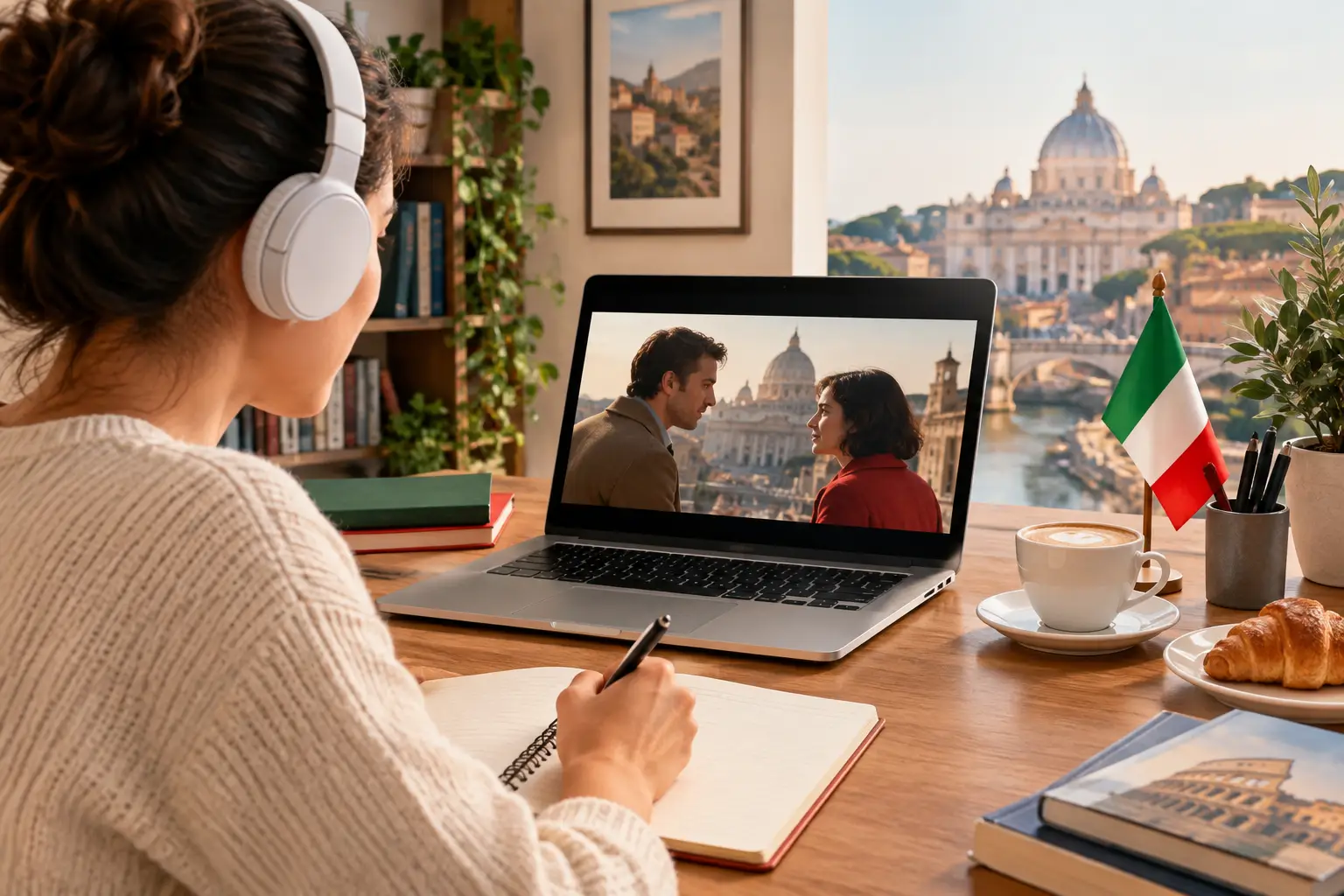
A student may understand every word in an Italian textbook dialogue, then feel completely lost when a family starts talking over dinner in a film. That gap is normal. Italian films for learners bring you closer to the pace, humor, interruptions, regional voices, and unspoken context of real conversation.
A movie will not replace guided speaking practice, but it can make the Italian you study feel lived-in. You begin to notice how often people say cioè, soften a request with magari, or use dai to encourage, persuade, and show impatience. The goal is not to understand every line on the first viewing. It is to train your ear to stay present when Italian moves naturally.
Why films help you learn real Italian
Films give words a situation. You do not just learn that figurati can mean you are welcome. You see a character say it with a smile, a shrug, or a quick wave of the hand. That combination of language, tone, and body language makes expressions easier to remember and safer to use in your own conversations.
They also show that there is no single, uniform Italian voice. A polished professional conversation in Milan, a family argument in Naples, and friends joking in Rome may differ in rhythm, vocabulary, and pronunciation. Standard Italian remains the foundation learners need, especially at the beginning. But hearing variation helps you avoid the surprise of expecting every native speaker to sound like an audio exercise.
Daniele often reminds students that listening is not a test of intelligence. It is a skill built through repeated contact with understandable input. Anna makes a similar point in lessons: when you can recognize the intention of a scene, you do not need to catch every word to follow the conversation. Films are particularly useful for practicing that habit.
How to choose Italian films for learners
Choose by level, but also by your interests. A slow, character-driven film you genuinely want to finish is more useful than an acclaimed classic that feels like homework. For beginners, animation and warm family comedies are often easier because the situation is visually clear. Intermediate learners can benefit from contemporary comedies and dramas with everyday dialogue. Advanced students can take on fast comedy, historical topics, and movies where regional speech matters to the story.
Whenever possible, start with Italian audio and Italian subtitles. English subtitles can help you decide whether you like a film, but they often pull your attention away from the Italian sentence. If Italian subtitles feel too difficult, use English subtitles for an initial viewing, then revisit one short scene in Italian.
Availability changes between streaming services and countries, so treat the suggestions below as a watchlist rather than a fixed syllabus.
10 Italian films for learners worth watching
1. Pane e tulipani (2000)
This gentle comedy-drama follows Rosalba, a woman who unexpectedly begins a new life in Venice. Its dialogue is often calm and relationship-focused, making it a good choice for intermediate learners. Listen for polite conversation, friendship, and the language people use when getting to know each other.
2. Benvenuti al Sud (2010)
A comedy about a northern Italian man transferred to southern Italy, this film gives learners plenty of accessible everyday interaction. It also plays with Italian regional stereotypes, so it is worth watching with a critical eye. The humor is useful precisely because it opens a conversation about assumptions, identity, and how Italians may tease one another.
3. Perfetti sconosciuti (2016)
A group of friends puts their phones on the table during dinner, with complicated results. The vocabulary is modern and highly useful: messages, relationships, secrets, excuses, and disagreement. The pace can be quick, so it suits solid intermediate or advanced learners who are ready for overlapping speech.
4. Il ciclone (1996)
Set in Tuscany, this popular comedy has a lively but approachable tone. It offers practical family language and informal exchanges, along with moments of regional flavor. Do not worry if you miss a joke at first. Comedies rely heavily on timing, and repeat viewing is part of the learning.
5. Mine vaganti (2010)
This family story takes place in Lecce and moves between affection, tension, and humor. It is especially useful for learners who want to hear how Italians negotiate family expectations without every conversation sounding formal or dramatic. Notice the ways characters soften opinions, interrupt, and change the subject.
6. Il postino (1994)
The story of a postman who befriends the poet Pablo Neruda has a slower rhythm than many modern comedies. That gives learners more room to hear complete phrases. The language is poetic in places, but the film is still a valuable choice for listening to emotion, hesitation, and growing confidence.
7. La mafia uccide solo d’estate (2013)
This coming-of-age story is set in Palermo and approaches a serious subject through a child’s perspective and dark humor. It is better for upper-intermediate learners because the historical and cultural context matters. Use it to practice following a story even when not every reference is familiar.
8. La vita è bella (1997)
Many learners know this film already, which can make it less intimidating. The first part includes playful, expressive Italian, while the later sections deal with the Holocaust and are emotionally difficult. It is not a light study choice, but it can be meaningful for advanced learners who want to pay attention to register, humor, and tone.
9. C’è ancora domani (2023)
Set in postwar Rome and filmed in black and white, this recent drama explores family life, gender roles, and social change. The dialogue and themes deserve patience, particularly because historical setting affects vocabulary and expectations. It can lead to thoughtful discussion about what has changed in Italian society and what kinds of family language still feel familiar.
10. Smetto quando voglio (2014)
This fast-paced comedy about underemployed academics is best saved for advanced learners. You will hear contemporary urban Italian, jokes, slang, and quick exchanges. It is a good reminder that progress includes learning to tolerate uncertainty: understanding the main idea of a rapid scene is a real achievement.
Turn one scene into a listening lesson
Watching passively is enjoyable. Watching one short scene actively is where progress happens. Pick a scene of one to three minutes, ideally one with a clear situation such as ordering, arriving home, making plans, or disagreeing with a friend.
Watch it once without pausing. Write down only the essentials: who is speaking, what they want, and how the mood changes. Then watch again with Italian subtitles and collect three useful expressions, not ten isolated words. For example, you might hear Che ne pensi? for asking an opinion, Non fa niente for reassuring someone, or Ci penso io for offering to handle something.
Finally, say two lines aloud. Copy the speaker’s rhythm rather than trying to perform perfectly. If a character says Ma dai, non è possibile!, notice where the emphasis falls and what feeling it carries. Then adapt the line: Ma dai, davvero? This small step turns recognition into speaking practice.
A quick scene exercise
Imagine a character says: Ti va di venire al cinema stasera? Reply naturally in Italian in each situation.
- You would like to go, but you are working late.
- You cannot go, but you suggest Saturday instead.
- You are unsure and need time to decide.
Possible answers: 1. Volentieri, ma stasera lavoro fino a tardi. 2. Stasera non posso. Magari sabato? 3. Non lo so ancora, ci penso e ti faccio sapere. Your wording can vary. What matters is that you communicate a clear, natural response.
Frequently asked questions about Italian films for learners
Should beginners watch Italian movies?
Yes, with realistic expectations. Beginners should choose visually clear stories, use short scenes, and focus on recognizing familiar words and emotions. Even ten minutes can be useful when you rewatch it instead of trying to finish a two-hour film.
Should I use Italian or English subtitles?
Italian subtitles are usually the better long-term tool because they connect sounds to spelling. English subtitles are fine for understanding a difficult plot, especially on a first viewing. The strongest approach is often English once, then Italian subtitles for selected scenes.
Are Italian films better than Italian TV shows for learning?
It depends on your routine. Films offer a complete story and a wide range of language in one sitting. TV shows provide recurring characters and more repetition over time. If your schedule is busy, a 15-minute episode segment may be easier to sustain than a full movie.
Will films teach me regional Italian dialects?
Films may expose you to dialects and regional accents, but they are not the best place to begin learning them. Build confidence in standard Italian first. Then use regional speech as listening practice and cultural insight, without feeling pressure to copy expressions you do not fully understand.
How many new words should I learn from a movie?
Three to five useful expressions from one scene is plenty. Prioritize phrases you could imagine saying in your own life. A small set you review and reuse will help more than a long vocabulary list you never revisit.
Choose one film that genuinely interests you, watch a short scene tonight, and keep one expression that sounds like something you would say. Bring it to your next Italian conversation or lesson. That is how screen Italian gradually becomes your Italian.