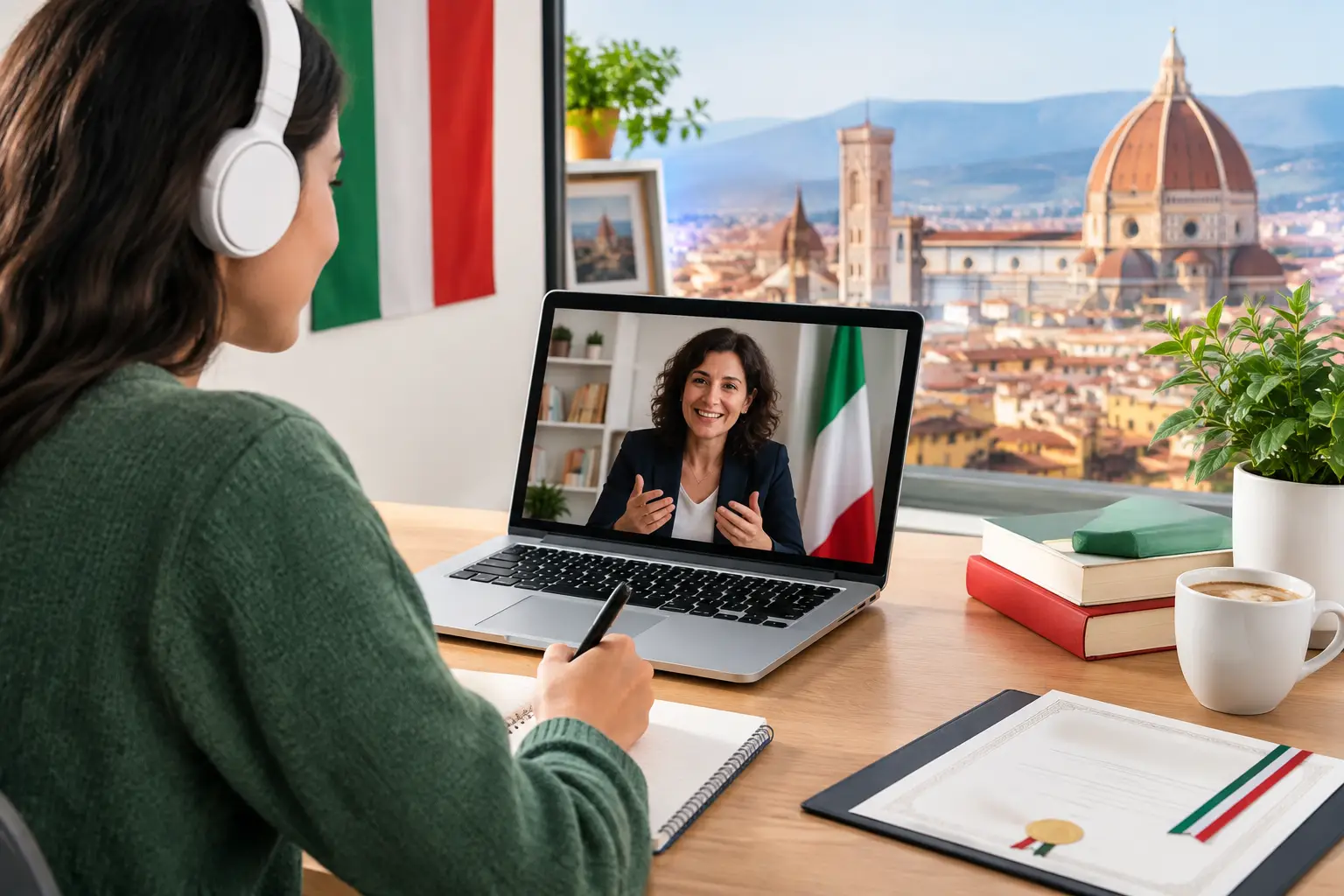
A polished profile can make almost any teacher look qualified. For adult learners, though, an Italian teacher credentials review should answer a more useful question: can this person help me speak, understand, and respond in real Italian?
A degree, certificate, or native-speaker background may all be valuable. None of them, by itself, guarantees a good lesson. The best choice depends on your goal, your current level, and how much guidance you need to turn what you know into conversation.
What credentials can tell you
Teacher credentials matter because they can reveal preparation, subject knowledge, and professional standards. But credentials are evidence, not a complete verdict. When you are choosing an Italian teacher online, look at the full picture: formal training, classroom experience, language background, lesson design, and the way the teacher communicates with learners.
A teacher with a degree in Italian language, literature, linguistics, education, or a related field may have a strong foundation in the language and its structure. This can be especially helpful when you want clear explanations of tricky areas such as the passato prossimo versus imperfetto, pronouns, or the congiuntivo.
Teaching-specific qualifications also deserve attention. Certifications in teaching Italian as a foreign or second language indicate that a teacher has studied how adults acquire Italian, how to sequence a course, and how to correct errors without stopping every conversation. Names vary by institution and country, so focus less on collecting acronyms and more on what the training actually covers.
Experience matters just as much. A teacher who has spent years working with English-speaking adults usually recognizes predictable difficulties. For example, English speakers often say sono 30 anni when they mean “I am 30 years old,” or use io sono freddo to mean “I am cold,” rather than ho freddo. A knowledgeable teacher hears the pattern, explains it simply, and gives you a reason to use the right form again.
Native speaker is valuable, but not the whole story
Many learners want a native Italian teacher, and for good reason. Native speakers offer natural pronunciation, current vocabulary, cultural context, and an instinct for what sounds normal in a given situation. They can help you hear the difference between textbook-correct Italian and the Italian you are likely to hear from a colleague, neighbor, or family member.
Still, being a native speaker is not automatically the same as being trained to teach. Speaking Italian since childhood does not necessarily prepare someone to explain why we say mi piace rather than a direct translation of “I like,” or to build a lesson for a beginner who feels nervous about speaking.
Anna often sees students relax when they learn that confusion is not a personal failure. Italian has patterns that take time to notice, particularly when English works differently. A skilled teacher makes those patterns visible, then returns to them in useful contexts instead of treating them as isolated rules.
The strongest combination is often a qualified native teacher who understands both authentic contemporary Italian and the learning journey of an adult student. That teacher can explain a grammar point in accessible English when needed, then bring the lesson back to Italian as quickly as possible.
How to conduct an Italian teacher credentials review
Start by reading beyond the headline on a teacher’s bio. “Certified” and “experienced” are useful words only when the details support them. Look for a clear description of education, teaching training, years or types of experience, levels taught, and areas of specialization.
Then consider whether the teacher’s experience matches your needs. A teacher who is excellent with advanced literature students may not be the right fit for a complete beginner preparing for a first trip to Italy. Likewise, a friendly conversation partner may not offer enough structure if you need Italian for university, professional communication, or a heritage-language goal.
Ask how lessons are organized. Good credentials should show up in the teaching itself: a logical progression, relevant materials, time to speak, feedback you can understand, and a way to review between classes. In a well-planned small group, you should not spend the entire hour listening to the teacher or waiting silently for your turn.
Daniele’s approach with adult learners is to create a useful balance. Students need correction, but they also need momentum. If every imperfect phrase is interrupted, many people begin to speak less. If errors are never addressed, those errors become habits. Effective teachers know when to let a conversation continue and when to pause for a correction that will make the next attempt stronger.
Questions worth asking before you enroll
You do not need to interrogate a teacher, but a few practical questions can save you time and money. Ask what levels they teach, whether they work with adult English speakers, and how they assess your starting point. Ask what happens between lessons: Are there notes, exercises, recordings, transcripts, or a clear way to revisit material?
It is also reasonable to ask how speaking is included. A course should not promise that you will simply “absorb” Italian through exposure alone. Conversation needs support. Beginners need useful phrases, repetition, and low-pressure chances to respond. Intermediate learners need targeted feedback and opportunities to tell stories, express opinions, and manage everyday misunderstandings.
For example, a practical early exchange might be:
Teacher: Che cosa fai nel fine settimana? Student: Di solito lavoro, ma domenica vado al mercato. Teacher: Bene. Con chi ci vai? Student: Ci vado con mia sorella.
This short dialogue practices present tense, time expressions, and the little word ci in a real response. Credentials have value when they lead to this kind of purposeful teaching.
Signs to treat with caution
A lack of formal credentials does not automatically mean poor teaching. Some excellent teachers have built deep expertise through years in the classroom. But be cautious when a profile is vague, makes dramatic promises, or treats grammar and conversation as opposites.
You may want to look elsewhere if a teacher cannot explain how lessons are structured, offers only generic worksheets, or presents “native speaker” as the only qualification. Also be wary of a one-size-fits-all approach. Adults come to Italian for different reasons, and a teacher should be able to adapt examples and practice to your life.
Watch for the opposite problem, too: impressive qualifications paired with lessons that feel overly academic. If your goal is to order lunch, talk with relatives, participate in meetings, or make friends in Italian, you need time with living language. You should practice phrases such as Mi può consigliare qualcosa? (“Can you recommend something?”) and Non ho capito, può ripetere? (“I didn’t understand, can you repeat?”), not only analyze verb tables.
Credentials and course design should work together
When evaluating an online school rather than one individual teacher, examine the system around the teacher. Qualified instructors are more effective when they have a coherent curriculum, small enough classes for everyone to participate, and resources that help students study independently.
Look for materials that extend the lesson without replacing it. Video clips, subtitles, transcripts, downloadable notes, short exercises, and review tests can all help busy adults retain what they learned. But the real test is whether those materials prepare you to communicate in class and beyond it.
At The Italian Lesson, we believe students benefit from both structure and genuine contact with Italian. That means clear progression, native-teacher input, and room for the questions that arise when language meets real life: Should I use tu or Lei? Does this phrase sound too formal? Why did that person say magari there?
FAQ: Italian teacher credentials review
What credentials should an Italian teacher have?
There is no single required credential for every situation. Look for relevant language or education training, preparation in teaching Italian to non-native speakers, and demonstrated experience with learners like you. A clear, well-designed lesson is as meaningful as a line of letters after a name.
Is a native Italian speaker always the best teacher?
A native speaker can provide valuable pronunciation, cultural insight, and natural language use. The best fit is usually a native speaker who also knows how to teach, explain, correct, and plan lessons for adult learners.
Do I need a teacher with a degree in Italian?
Not always. A degree can be useful, especially for advanced study or complex grammar, but teaching skill and relevant experience also matter. For conversational goals, prioritize a teacher who helps you actively use Italian.
How can I tell if an online Italian teacher is qualified?
Read the teacher’s background, ask about training and experience, and examine the course structure. You should be able to see how your level is assessed, how speaking is practiced, and how you receive feedback.
Are group Italian classes less personal than private lessons?
It depends on class size and design. Small groups can be highly interactive and offer the useful experience of listening to other learners. Private lessons provide more individual pacing. Both work well when the teacher is prepared and the course gives you regular speaking time.
The right teacher will not make Italian feel effortless every day, because meaningful learning asks something of you. They will make the next step clear, give you language you can use immediately, and help you keep speaking even when the sentence is not perfect.