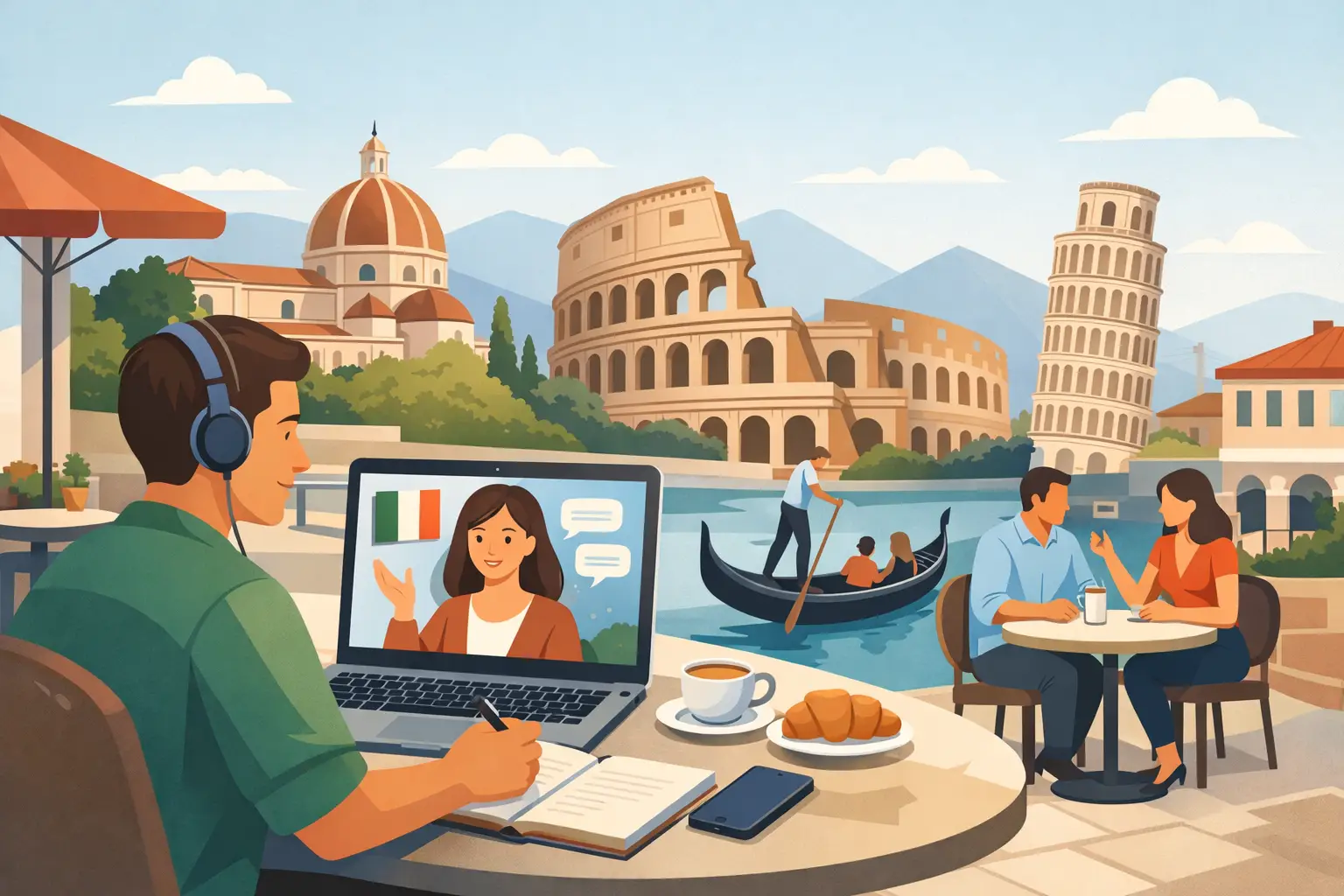
A student can collect dozens of Italian apps, save hundreds of vocabulary posts, and still freeze when someone asks, Come stai? The problem is rarely motivation. More often, it is that the Italian learning resources are not working together.
For adult learners, the best resources do more than explain a rule or introduce a word. They help you recognize Italian at natural speed, respond without translating every sentence, and understand why a phrase changes depending on the person, setting, or region. A good learning plan is not about having everything. It is about choosing a few reliable tools that move you toward real conversation.
What Italian learning resources should actually do
A useful resource should have a clear job. A structured course gives you progression: what to learn first, what to revisit, and how grammar connects to communication. Live lessons give you the part most self-study materials cannot provide – immediate interaction, correction, and the experience of responding in the moment.
Listening materials train your ear for connected speech. Reading gives you repeated exposure to vocabulary and sentence patterns. Short writing tasks help you notice gaps you may not hear when you speak. The resources are different, but they should support the same goal: expressing something meaningful in Italian.
Daniele often sees students who know the present tense well but have only practiced it in isolated sentences. They can say io lavoro but hesitate when they need to say, Di solito lavoro da casa, ma oggi sono in ufficio – I usually work from home, but today I am in the office. The difference is context. Resources become more valuable when they regularly ask you to connect language to your own life.
Start with one structured path
If you are a beginner, make a structured course or regular class your main resource. Italian grammar is not impossible, but it is interconnected. Gender, articles, adjective endings, verb forms, and prepositions make much more sense when they are introduced in a sensible order.
This does not mean waiting until your grammar is perfect before speaking. It means learning enough structure to make your speaking useful. After learning essere and avere, for example, practice a small exchange rather than memorizing a chart alone:
Come sei di carattere? Sono abbastanza tranquillo, ma anche curioso.
The grammar is simple, but the answer is personal. That is the kind of practice that stays with you.
For intermediate learners, structure matters in a different way. You may need to identify the gaps that keep recurring: past tenses, pronouns, the subjunctive, or simply building longer answers. A teacher can help separate what you have not learned from what you know but do not yet use comfortably.
Build your listening around real voices
Listening is where many independent learners become discouraged. They understand carefully recorded beginner audio, then hear two Italians speaking and feel as if they have learned nothing. This is normal. Spoken Italian includes shortened sounds, interruptions, regional accents, humor, and words that are implied rather than stated.
Start with material that includes audio and a transcript or subtitles. Listen once for the general meaning. Then listen again while reading. Notice small but frequent expressions such as cioè, allora, magari, and dai. These words do not always have one neat English translation, but they do a great deal of conversational work.
For example, magari can mean maybe, if only, or that would be nice, depending on context:
Andiamo al mare domenica? Magari! Ma devo lavorare.
Here, Magari! is closer to I wish or I would love to. A vocabulary list can tell you possible meanings. A real dialogue teaches you when the expression feels natural.
Anna encourages learners not to treat listening as a test they either pass or fail. If you understand the situation, a few key words, and the speaker’s attitude, you are already building an essential skill. Return to short clips several times rather than constantly moving on to new material.
Make speaking part of the resource, not the reward
Many learners treat conversation as something they will do later, after completing more lessons. In practice, speaking needs to begin early, even if your sentences are short. The goal at first is not speed. It is becoming comfortable producing Italian before you have time to overthink it.
Use every new topic as a speaking prompt. When you study food, do not only memorize pane, formaggio, and acqua. Say what you actually like, order an imaginary lunch, or explain what you make when you have little time. When you study the past tense, tell a friend about your weekend in three sentences.
A live class or private lesson is especially useful because another person responds. They may ask, Ah sì? E con chi sei andato? Suddenly, you need language for who, where, when, and what happened next. That small pressure is productive. It reveals the words and structures you need next.
If you are studying alone between lessons, record a one-minute voice note for yourself. Choose a practical topic: your workday, a movie you watched, a family tradition, or plans for the weekend. Listen back once. You are not looking for perfection. Notice one phrase you could say more naturally next time.
Choose culture resources that give language a setting
Culture is not an extra after grammar. It helps you understand what people mean and how they relate to each other. Italian changes with formality, age, place, and relationship. A phrase that is warm among friends may be too informal in a first email to a professor or colleague.
Consider the difference between Ciao, come va? and Buongiorno, come sta? Both are greetings, but they create different social distances. Learning this through real interviews, television scenes, podcasts, and conversations is more memorable than reading a note that says formal versus informal.
It also helps to avoid treating Italy as a single, fixed culture. Everyday language in Milan, Naples, Palermo, Bologna, and smaller towns can sound different. People may use local words, speak at different speeds, or have different conversational habits. Standard Italian gives you a shared foundation; exposure to variety makes that foundation flexible.
Choose cultural material connected to something you already care about, whether that is contemporary life, design, cinema, opera, sports, family stories, or university study. Interest keeps you returning, and repeated contact is what turns recognition into active language.
A realistic weekly resource routine
Busy adults do not need a two-hour study session every day. They need a routine with enough repetition to keep Italian present in their mind. Three focused study sessions and one live speaking opportunity can be more effective than an ambitious plan that disappears after ten days.
Try pairing your resources by purpose. On one day, complete a section of your course and write down three phrases you would use personally. On another, listen to a short Italian conversation twice, first without and then with a transcript. Later in the week, use those phrases in a lesson, a voice note, or a short written message.
Keep a small phrase notebook, digital or paper. Do not fill it with random single words. Save complete, reusable chunks such as non vedo l’ora di… for I cannot wait to, mi sono reso conto che… for I realized that, or dipende da… for it depends on. These phrases help you speak more naturally because you are not constructing every sentence from zero.
At The Italian Lesson, this is why structured instruction is paired with authentic materials, practice activities, and opportunities to speak with native Italian teachers. A resource works best when it gives you both guidance and a reason to use what you learned.
Frequently asked questions about Italian learning resources
What are the best Italian learning resources for beginners?
Beginners usually need a structured course, clear audio, and regular speaking practice. Start with essential grammar and high-frequency vocabulary, but use them immediately in simple personal exchanges. Avoid relying only on flashcards or word lists.
Can I learn Italian with self-study resources only?
You can make real progress independently, especially in reading, listening, and grammar. But speaking is harder to evaluate alone. Even occasional lessons with a qualified native teacher can help you catch repeated errors, improve pronunciation, and practice spontaneous conversation.
How many Italian resources should I use at once?
For most learners, three is enough: one main structured resource, one source of listening input, and one way to practice speaking. Add more only when you know exactly what problem the new resource solves.
Should I learn Italian from movies and TV shows?
They can be excellent for listening, rhythm, gestures, and everyday expressions, particularly when you use Italian subtitles or transcripts. They work best as support for a learning plan, not as the only source of instruction, because dialogue may be fast, slang-heavy, or specific to a character and setting.
Why do I understand Italian but struggle to speak it?
Understanding is a recognition skill; speaking requires quick recall, sentence-building, pronunciation, and confidence at the same time. Practice short responses aloud, reuse familiar phrases, and speak regularly before you feel fully ready. The gap narrows through use, not through waiting.
The resource that matters most is the one you will return to next week. Choose materials that make Italian feel connected to your own voice, then give yourself frequent chances to use that voice with another person.