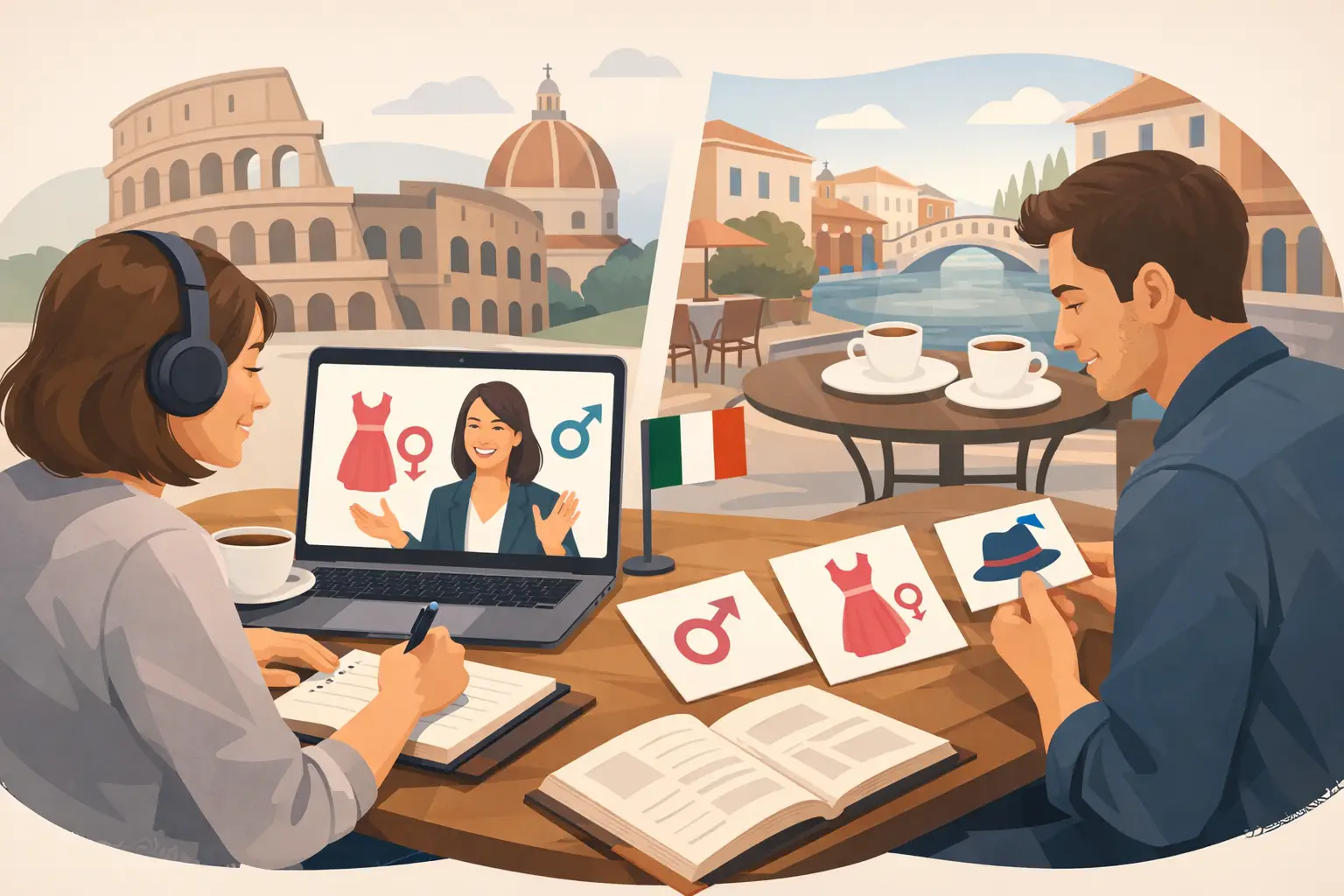
A student once asked Daniele why a table is masculine in Italian while a chair is feminine. It is a fair question: il tavolo and la sedia have no biological sex. The short answer to why Italian words have gender is history, not logic. The useful answer is that gender gives Italian a system of patterns that helps words work together in a sentence.
For English speakers, grammatical gender can feel like an extra rule to memorize. But once you stop looking for a real-world reason that a book is masculine or a window is feminine, it becomes much less frustrating. Gender is simply part of each noun’s identity, much like its plural form. Learn it with the word, and Italian starts to sound more natural.
Why Italian Words Have Gender
Italian inherited grammatical gender from Latin. Latin had masculine, feminine, and neuter nouns. Over many centuries, the neuter category mostly disappeared in everyday Italian, and its words were absorbed into the masculine or feminine groups. What remains is the two-gender system you meet today: masculine and feminine.
This is not unique to Italian. Many languages organize nouns by gender, although they do it in different ways. In Italian, gender affects the small words and descriptions around a noun: articles, adjectives, and sometimes past participles. It creates agreement, which helps listeners see which words belong together.
Take these examples:
- il libro interessante – the interesting book
- la lezione interessante – the interesting lesson
- i libri interessanti – the interesting books
- le lezioni interessanti – the interesting lessons
The adjective changes to match the noun. At first, that may seem like more work. In real conversation, though, those endings provide useful signals. If you hear una bellissima città, you already know the speaker is talking about a singular feminine noun, even before you hear città.
Gender is grammatical, not a judgment about things
Some nouns referring to people follow natural gender: ragazzo is a boy, and ragazza is a girl. But most objects, ideas, and places have arbitrary grammatical gender. A sun is masculine in Italian (il sole) and feminine in French (le soleil is also masculine, but in German it is feminine: die Sonne). There is no universal rule behind these choices.
That is why asking “Why is mano feminine?” has a historical answer, but rarely a shortcut that makes it instantly memorable. The practical question is: how can you recognize and retain its gender when you need it?
The Patterns That Help Most Beginners
Italian noun endings offer strong clues.
They are not perfect rules, but they are reliable enough to make an intelligent first guess.
🟢 -O → usually masculine
Most singular nouns ending in -o are masculine:
- il ragazzo
- il libro
- il mercato
🔴 -A → usually feminine
Most singular nouns ending in -a are feminine:
- la casa
- la porta
- la famiglia
🟡 -E → can be either gender
Nouns ending in -e can be either gender. You have to learn them individually:
| Masculine | Feminine |
|---|---|
| il ristorante | la notte |
| il ponte | la chiave |
Their plural endings will tell you the gender once you know it: masculine -e nouns usually become -i, while feminine -e nouns usually become -i too.
So the plural does not always solve the mystery.
⭐ A few common endings are especially helpful.
Nouns ending in -zione and -sione are generally feminine:
- la stazione
- la conversazione
- la decisione
Nouns ending in -ma that come from Greek are often masculine:
- il problema
- il programma
- il sistema
These patterns are worth learning because they appear frequently in adult conversation.
⚠️ There are exceptions, and some are very common.
La mano is feminine despite ending in -o.
Il giorno is masculine, while la foto is feminine.
Rather than treating exceptions as evidence that Italian has no rules, think of them as high-frequency words that deserve their own flashcards and plenty of repetition.
How Gender Changes the Italian You Speak
You can sometimes be understood with the wrong gender, especially if the meaning is clear. If you say ho visto un bella casa, the listener will understand that you saw a beautiful house. But it sounds unfinished to an Italian ear. The natural sentence is ho visto una bella casa.
Gender matters most in three places: articles, adjectives, and possessives. Compare il mio amico italiano with la mia amica italiana. The changes are small, but they carry meaning and make your speech flow properly.
It also matters when you use pronouns. If someone asks, Dov’è la chiave? you can reply, L’ho trovata – I found it. The final -a matches la chiave, a feminine noun. With il biglietto, you would say L’ho trovato.
Anna often sees adult learners hesitate here because they are trying to build every word from scratch. That is understandable, but everyday fluency comes faster when you learn whole, useful pieces of language. Instead of memorizing chiave alone, learn dov’è la chiave? and ho trovato la chiave. The gender agreement then becomes part of a phrase your ear recognizes.
How to Learn Italian Noun Gender Without Guessing
The most effective habit is simple: never learn a noun by itself. Learn the article with it. Not tavolo, but il tavolo. Not lezione, but la lezione. When the plural is useful, add that too: il tavolo, i tavoli; la lezione, le lezioni.
Color can help in your notes, provided it does not become a crutch. For example, use one color for masculine nouns and another for feminine nouns. More importantly, say the article out loud. Italian is a spoken language, and your mouth learns patterns as well as your memory does.
Build vocabulary in connected groups. If you are preparing for a trip, practice la stazione, il biglietto, la valigia, and il binario inside short sentences. If you are talking about work, learn la riunione, il progetto, l’email, and il cliente in realistic context.
A small dialogue is more useful than a column of isolated words:
A: Dov’è la mia valigia? B: La valigia è vicino alla porta. A: E il mio biglietto? B: Il biglietto è sul tavolo.
You are not only seeing the genders. You are hearing articles, possessives, and prepositions work together.
Do not wait to speak until every ending is perfect
Accuracy matters, but it develops over time. Beginners should notice gender from the start, because it is much easier to build a good habit than replace an old one later. At the same time, do not let fear of il versus la stop you from ordering coffee, introducing yourself, or joining a conversation.
A native teacher can correct the mistakes that matter most and let less important ones pass while you are trying to communicate. In live classes at The Italian Lesson, that balance is central: you need enough correction to improve, and enough space to keep speaking.
FAQ: Italian Word Gender
Is every Italian noun masculine or feminine?
Almost every Italian noun is grammatically masculine or feminine. There are a few special cases, including some nouns with unusual plural forms, but the two-gender system is what learners use in everyday Italian.
How can I tell if an Italian word is masculine or feminine?
Check the article in a reliable dictionary or vocabulary resource, then learn the noun with that article. Endings such as -o and -a are useful clues, while nouns ending in -e need more individual attention.
Why is la mano feminine when it ends in -o?
Mano comes from a Latin feminine noun. It is one of the most common exceptions to the usual -o masculine pattern. Learn it as a complete unit: la mano, le mani.
Do Italian adjectives always agree with gender?
Most adjectives agree with the noun they describe. Some adjectives have four forms, such as italiano, italiana, italiani, italiane. Others, particularly many ending in -e, use the same singular form for masculine and feminine nouns, such as interessante.
Will Italians understand me if I use the wrong gender?
Usually, yes, especially in a simple sentence with clear context. But correct gender makes you easier to follow and helps your Italian sound more natural. Aim for progress, not silence.
Every il and la you learn is a small piece of the sentence you will later say without stopping to translate. Treat gender as part of the music of Italian, and give it time to become familiar.