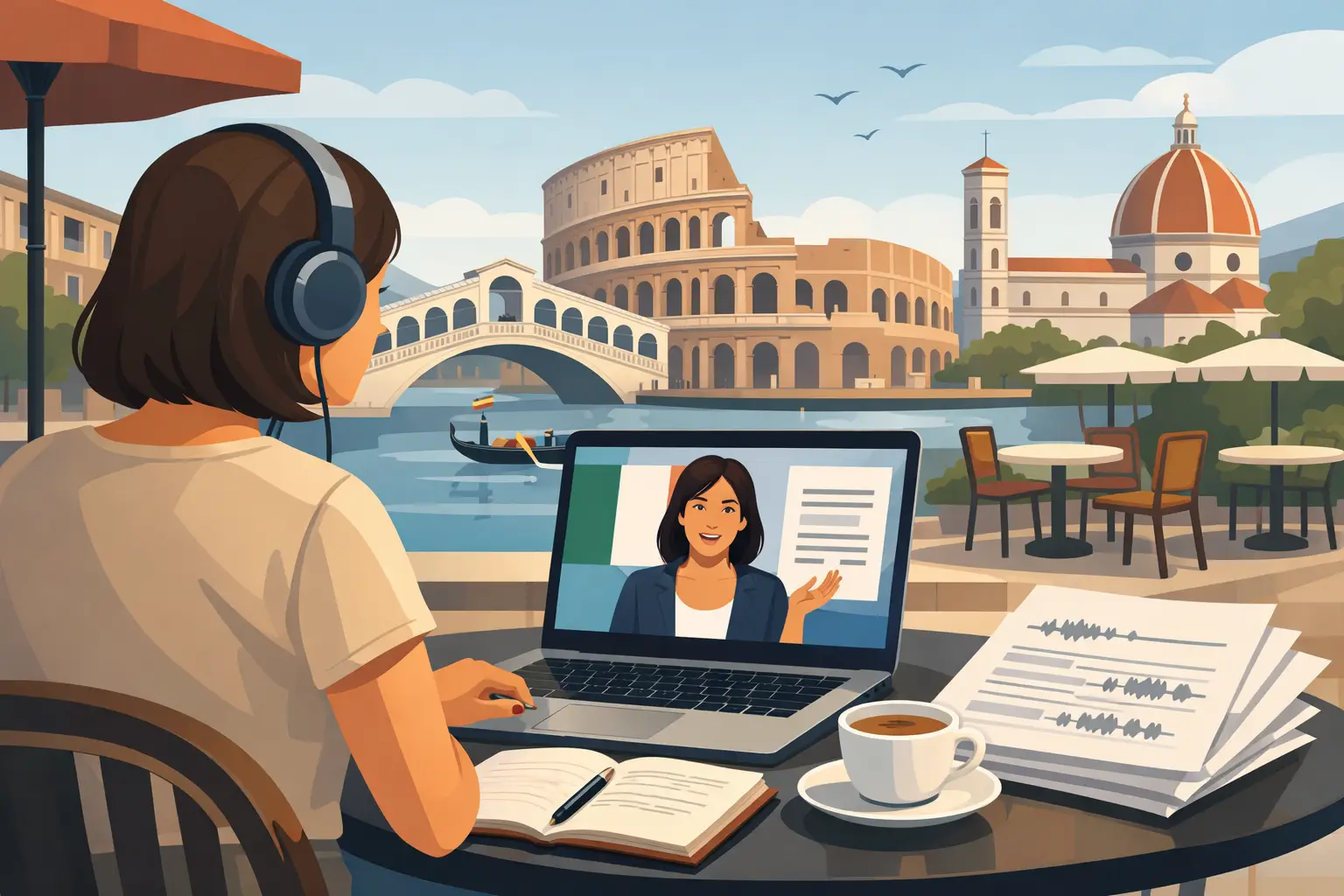
You can listen to ten minutes of Italian and feel either motivated or completely lost. Usually, the difference is not your talent. It is the method. For many adult learners, italian listening practice with transcripts is what turns Italian from a blur of sounds into language you can actually follow, reuse, and speak.
This matters even more if you have already studied grammar and still freeze when native speakers talk at a normal pace. Daniele and Anna have both seen this with adult students from very different backgrounds – professionals, heritage learners, travelers, and long-time hobby learners. Many can read a short text well, but when they hear the same ideas in real speech, everything suddenly feels faster, messier, and less familiar. That is normal. Spoken Italian has rhythm, reductions, linking, and regional flavor that textbooks rarely prepare you for.
Why italian listening practice with transcripts works
A transcript gives you a bridge between written Italian and spoken Italian. Without that bridge, many learners guess too much. They hear one known word, miss the next five, and then the whole sentence is gone.
With a transcript, you can check what was actually said instead of what you think you heard. This sounds simple, but it changes everything. You begin to notice that the problem is not always vocabulary. Sometimes it is word boundaries. Sometimes it is a familiar phrase pronounced quickly. Sometimes it is a verb form you know on paper but do not recognize in real speech.
This is one reason transcript-based listening is so effective for adults. It reduces frustration while keeping the challenge. You are still working with authentic sound, but you are not doing it blind.
There is also a confidence benefit. When students reread a transcript after listening, they often say, “I know these words. I just didn’t catch them.” That realization is powerful. It shows that progress is often closer than it feels.
What makes a good listening text
Not every transcript-based activity helps in the same way. A useful audio text should match your level closely enough that you can follow the main idea, but not so closely that you never meet anything new.
For beginners, shorter audio with clear pronunciation is usually better than fast, highly idiomatic conversation. For intermediate learners, this changes. If every recording is slow and perfectly articulated, you may understand the lesson but still struggle in real conversation. At that stage, natural speed with transcript support becomes much more valuable.
Anna often encourages students to choose audio around familiar situations first: introducing yourself, ordering food, describing your day, talking about family, making plans. The topic helps because your brain can predict likely language. That prediction is part of real listening.
A good transcript should also be accurate and easy to read. If it includes punctuation that reflects pauses and sentence structure well, it becomes much easier to map sound onto meaning.
How to use transcripts without becoming dependent on them
The biggest mistake is reading first and listening second every time. If you do that, you train reading more than listening.
A better approach is to separate the stages. First, listen once without looking at the text. Your goal is not perfect understanding. Just catch the situation, tone, and a few key words. Is the speaker inviting someone out? Explaining a problem? Telling a story about yesterday?
Then listen again and write down what you think you heard. Even two or three phrases are enough. This step forces active attention.
After that, read the transcript carefully. Now you compare. Which words did you hear correctly? Which ones surprised you? Where did spoken Italian connect words in a way that hid them from you?
Then go back to the audio and listen again with the transcript. This is where improvement becomes very concrete. You are no longer hearing random sound. You are hearing structure.
Finally, listen one more time without the transcript. This last pass is important because it checks whether the support actually helped your listening, not just your reading.
A simple routine that works
If you only have fifteen or twenty minutes, that is enough. Consistency matters more than marathon sessions.
Step 1: First listen for the big picture
Listen once with no text. Ask yourself three questions: Who is speaking? What are they talking about? Is the tone formal, casual, friendly, annoyed?
Step 2: Read the transcript actively
Do not just skim. Mark expressions, verb forms, and chunks of language you want to remember. For example, if you hear:
“Ci sentiamo più tardi?”
A learner may know sentire as “to hear,” but in context this means “Shall we talk later?” or “I’ll talk to you later.” That is exactly the kind of real-use Italian transcripts help clarify.
Step 3: Listen again and notice sound patterns
Pay attention to what made the sentence hard. Did the speaker reduce vowels? Did words run together? Did intonation signal a question before the grammar did?
Step 4: Repeat aloud
This step is often skipped, but it is one of the best ways to improve both listening and speaking. Read one or two lines aloud while following the audio rhythm. You do not need to sound perfect. You are training your ear to expect natural Italian phrasing.
Daniele often points out that learners who repeat short sections aloud start recognizing those same patterns much faster in future listening tasks.
What to focus on at each level
Beginners
At A1-A2, use short recordings and short transcripts. Focus on high-frequency language, present tense, everyday questions, and predictable contexts. If the transcript is too dense, listening becomes decoding torture instead of training.
Useful beginner goals include hearing greetings clearly, catching question words like dove, quando, perché, and recognizing common chunks such as non lo so, va bene, and mi dispiace.
Intermediate learners
This is where transcript work becomes especially valuable. At B1-B2, the challenge is not only vocabulary. It is speed, connected speech, and the fact that speakers do not always choose the textbook phrase.
For example, a student may expect “voglio andare” and then hear “vorrei andare” or “mi piacerebbe andare.” The transcript reveals not just what was said, but how Italians naturally express ideas with more nuance.
Advanced learners
At advanced levels, use transcripts to notice style, register, and cultural tone. Why does one speaker sound warm and informal while another sounds distant or professional? Why does a simple expression fit one context but not another?
This is where podcasts, interviews, and discussion-based audio become especially helpful. The transcript lets you study how real speakers manage agreement, hesitation, emphasis, and politeness.
Common problems and how to fix them
If you understand the transcript but not the audio, the issue is usually sound recognition. Slow down the clip and replay small sections.
If you understand individual words but not the sentence, the issue may be structure. Look at verb forms, pronouns, and connectors. Italian often packs meaning into small words that learners overlook.
If you can follow practice audio but not native conversation, your material may be too controlled. Add some less scripted listening, but keep transcript support.
If you rely too much on reading, reduce transcript time gradually. Try listening twice before checking the text.
For a helpful reference on proficiency levels, the CEFR framework is useful: https://www.coe.int/en/web/common-european-framework-reference-languages. For examples of authentic Italian language and culture, Rai Cultura offers valuable material: https://www.raicultura.it. Treccani is also excellent when you want to check usage and meaning in context: https://www.treccani.it.
FAQ
Is italian listening practice with transcripts good for beginners?
Yes, as long as the audio is short and level-appropriate. Beginners benefit most when the transcript supports very common vocabulary and everyday situations.
Should I read the transcript before listening?
Usually no. Listen first if you can. Even a partial first attempt trains your ear better than starting with the written text.
How often should I do Italian listening practice?
A short daily routine is usually more effective than one long weekly session. Fifteen focused minutes can produce strong results over time.
Can transcripts help me speak better, not just understand more?
Yes. If you repeat phrases aloud and notice common sentence patterns, transcripts can improve pronunciation, rhythm, and conversational phrasing.
What kind of audio should I choose for intermediate Italian listening practice with transcripts?
Choose natural conversations, short stories, or topic-based lessons with clear transcripts. You want material that sounds real but is still understandable with support.
Why do I know the words on the page but miss them in speech?
Because spoken Italian connects sounds differently from written Italian. This is normal. Transcript work helps your ear catch familiar language in its real form.
If listening has felt like the part of Italian that never quite clicks, do not treat that as a sign that you are bad at languages. More often, it means you need better practice, not more pressure. With the right audio, a clear transcript, and a routine you can actually keep, spoken Italian starts sounding less like noise and more like something you can join.